How to Get Motivated When You Don't Feel Like It
You've probably noticed that it's hard to be motivated all the time.
No matter what you are working on, there are bound to be days when you don't feel like showing up. There will be workouts that you don't feel like starting. There will be reports that you don't feel like writing. There will be responsibilities that you don't feel like handling. And there will be “off days” when your energy and emotions are in the gutter.
These fluctuations are part of life, and I face these motivational challenges just as much as the next person. A familiar routine can help with those off days.
Let's talk about how that works.
What baseball can teach you about getting motivated
One thing that makes baseball different from many other sports is the sheer number of games that are played. Major League Baseball teams play 162 games in a regular season.
With so many games, there will always be days when you don't feel motivated, when your body is tired, or you're just not mentally “up” for the game. In that way, baseball is a lot like life. There will always be days when the things that are important to you feel like a grind.
The game still has a start time. A pre-game routine can help a player move into the work while those lackluster feelings are still there.
Here's what a pitcher's pre-game routine can look like:
Grab a baseball and a glove. Jog out to the outfield foul pole. Jog across along the outfield wall. Stop at the opposite foul pole. Stretch hips and hamstrings. Jog back along the outfield wall. Toss lightly, working back to 75 feet or so. Head to the bullpen. Stand one step behind the mound and toss three or four times from there to the catcher. Step up onto the mound. Toss a few pitches without going into the full windup. Start throwing from the windup for ten pitches or so. Throw from the stretch for ten pitches or so. Finish with one of each pitch: changeup, curveball, fastball in, fastball out. Walk to the dugout.
That whole sequence can take twenty to twenty-five minutes, repeated the same way each time.
It physically warms up the player. It also gives the mind a way into the game. By the end, the player has spent twenty minutes preparing, throwing, and responding to what is happening.
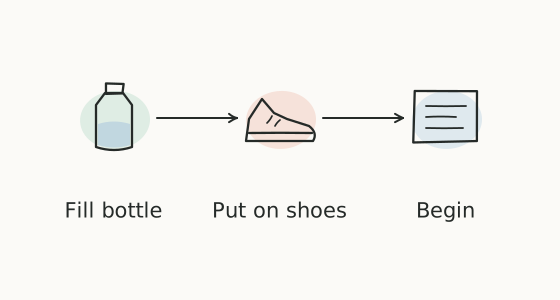
Imagine having a routine that could help pull you into “exercise mode” or “work mode” when motivation is low at the start.
If you look at performers in different fields, you'll see similar patterns all over the place. NBA players who do the same thing before every free throw. Comedians who recite the same words before they step onto the stage. People who follow the same meditation sequence every morning.
Do you think these people always feel motivated? No way. There are some days when the most talented people in the world wake up feeling like sluggish lard bombs.
They have a routine to begin. You can use the same idea to exercise, study, write, speak, or perform another task that is important to you.
Here's how to do it.
1. Start with something easy
A good pre-game routine starts with an action that requires very little motivation.
For example:
- A writing routine could start by getting a glass of water.
- A weightlifting routine could start by putting on your lifting shoes.
- A pitching routine could start by picking up a baseball and a glove. (The coach will probably remind you if you forget.)
Motivation often comes after starting. That's why your pre-game routine needs to be easy to begin.
You could create an exercise routine that starts with filling up your water bottle. When you don't feel like working out, you can tell yourself, “Just fill up the water bottle.” Your only goal is to start the routine and then continue from there.
2. Move toward the work
Most of the time, your routine should include physical movement. It's hard to think yourself into getting motivated.
What is your body language like when you're feeling unmotivated or lacking energy?
Answer: you're probably not moving very much. Maybe you're slumped over like a blob, slowly melting into the couch.
Getting up and moving can help you feel more engaged. Think about dancing, or simply stepping outside after sitting for a long time. The physical action changes what you have to pay attention to.
Your routine can begin with a small movement and gradually bring you closer to the task. Physical movement doesn't have to mean exercise. If your goal is to write, your routine should bring you closer to the physical act of writing. Get the notebook. Sit down. Open it to the page where you left off.
3. Follow the same pattern
The purpose of a pre-game routine is to create a series of events that you perform before a specific task. The routine tells your mind, “This is what happens before I do this.”
Over time, the sequence becomes familiar. You know where it leads. You have a reminder that helps begin the habit even when motivation is low.
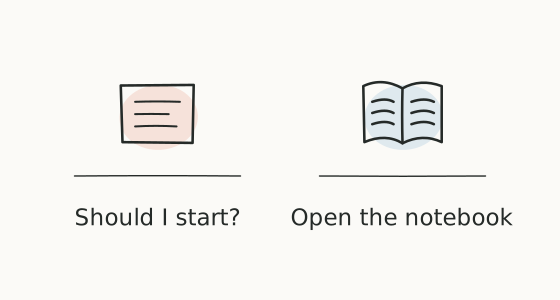
This matters because when you don't feel motivated, figuring out what to do next can become another obstacle. Should you work now? Should you answer email first? Which part should you begin with?
The routine answers a few of those questions in advance. You know what to do next. You can follow the pattern.
Use it on the good days, too. These small behaviors reinforce the habit and the feelings that come with it. The beginning becomes familiar through repetition. When you have a flat day, you can pick up the ball and glove, fill the bottle, or open the notebook. You have a first action ready.