How to Start New Habits That Actually Stick
What you repeatedly do (what you spend time thinking about and doing each day) helps form the person you are, the things you believe, and the personality that you portray.
But what if you want to improve? What if you want to form new habits? How would you go about it?
There's a helpful framework that can make it easier to stick to new habits. Let's talk about that framework now.
How habits work
The process of building a habit can be divided into four simple steps: cue, craving, response, and reward.
Breaking it down into these fundamental parts can help us understand what a habit is, how it works, and how to improve it.
First, there is the cue. The cue triggers your brain to initiate a behavior. It is a bit of information that predicts a reward. Some cues signal the location of primary rewards like food and water. Others predict rewards like money, praise and approval, love and friendship, or a sense of personal satisfaction.
Your mind is continuously analyzing your internal and external environment for hints of where rewards are located. Because the cue is an indication that we're close to a reward, it can lead to a craving.
Cravings are the second step of the habit loop. Without some level of motivation or desire, we have little reason to act. What you crave is a change in how you feel. A cigarette promises relief. Brushing your teeth gives you the feeling of a clean mouth. Television offers entertainment. The craving is linked to a desire to change your internal state.
Cravings differ from person to person. In theory, any piece of information could trigger a craving, but in practice, people are not motivated by the same cues. For a gambler, the sound of slot machines can be a potent trigger that sparks an intense wave of desire. For someone who rarely gambles, the jingles and chimes of the casino are just background noise. Cues are interpreted. The thoughts, feelings, and emotions of the observer are what transform a cue into a craving.
The third step is the response. The response is the actual habit you perform, which can take the form of a thought or an action. Whether a response occurs depends on how motivated you are and how much friction is associated with the behavior. If a particular action requires more physical or mental effort than you are willing to expend, then you won't do it. Your response also depends on your ability. It sounds simple, but a habit can occur only if you are capable of doing it. If you want to dunk a basketball but can't jump high enough to reach the hoop, well, you're out of luck.
Finally, the response delivers a reward. The cue is about noticing the reward. The craving is about wanting the reward. The response is about obtaining the reward. Rewards serve two purposes: they satisfy us and they teach us.
The first purpose of rewards is to satisfy your craving. Rewards provide benefits on their own. Food and water deliver the energy you need to survive. Getting a promotion can bring more money and respect. There is also the immediate feeling of satisfying your craving to eat, to gain status, or to win approval. At least for a moment, rewards deliver contentment and relief from craving.
Second, rewards teach us which actions are worth remembering in the future. Your brain is a reward detector. As you go about your life, you are continuously monitoring which actions satisfy your desires and deliver pleasure. Feelings of pleasure and disappointment are part of the feedback mechanism that helps your brain learn which actions to repeat. Rewards close the feedback loop and complete the habit cycle.
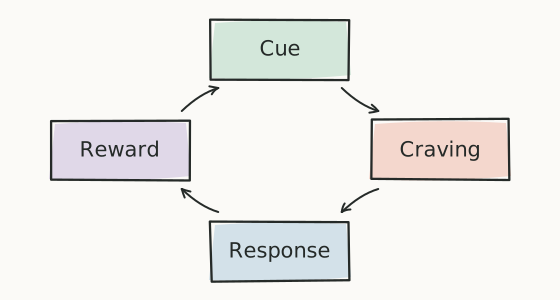
If something is missing in one of the four stages, a behavior can be harder to repeat. Eliminate the cue and you may forget to start. Reduce the craving and you may have little motivation to act. Make the behavior too difficult and you won't be able to do it. And if the reward fails to satisfy your desire, then you'll have less reason to do it again in the future.
The four stages are best described as a feedback loop. This “habit loop” is continually scanning the environment, predicting what will happen next, trying out different responses, and learning from the results.
We can split these four steps into two phases: the problem phase and the solution phase. The problem phase includes the cue and the craving, and it is when you realize that something needs to change. The solution phase includes the response and the reward, and it is when you take action and experience the result.
Sometimes the problem is that you notice something good and you want to obtain it. Sometimes the problem is that you are experiencing pain and you want to relieve it.
Let's cover a few examples of what this looks like in real life.
- Your phone buzzes with a new text message. You want to learn the contents of the message. You grab your phone and read the text. You satisfy your curiosity, and grabbing your phone becomes associated with your phone buzzing.
- You are answering emails. You begin to feel stressed and overwhelmed by work. You want to feel in control, so you bite your nails. You experience some relief, and biting your nails becomes associated with answering email.
- You wake up. You want to feel alert. You drink a cup of coffee. The feeling of alertness that follows helps associate coffee with waking up.
- You smell a doughnut shop as you walk down the street near your office. You begin to crave a doughnut. You buy a doughnut and eat it. You satisfy the craving, and buying a doughnut becomes associated with walking down that street.
- You hit a stumbling block on a project at work. You feel stuck and want to relieve your frustration. You pull out your phone and check social media. You feel some relief, and checking social media becomes associated with feeling stalled at work.
The entire process can be completed in a split second, and we use it again and again without realizing everything that has been packed into the previous moment.
Imagine walking into a dark room and flipping on the light switch. You have performed this simple habit so many times that it occurs without thinking. You walk into a dark room, want to be able to see, flip the switch, and can see. Turning on the light switch becomes associated with being in a dark room.
By the time we become adults, we rarely notice many of the habits that are running our lives. Most of us never give a second thought to the fact that we tie the same shoe first each morning, or unplug the toaster after each use, or always change into comfortable clothes after getting home from work. After years of repetition, we automatically slip into these patterns of thinking and acting.
Using the framework
We can turn these four steps into practical questions about a habit we want to build:
- How can I make it obvious?
- How can I make it attractive?
- How can I make it easy?
- How can I make it satisfying?
For reading, that might mean leaving the book beside the chair where you sit after dinner. Choose something you actually want to read. Begin with a few pages. Give yourself enough quiet to enjoy them.
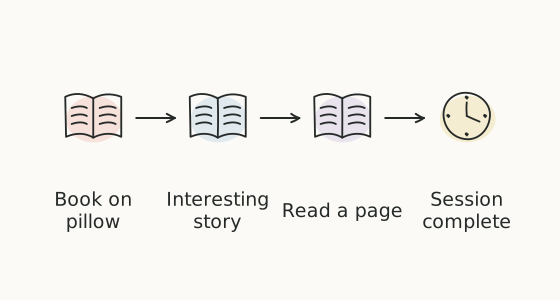
Each part gives you something concrete to look at. If you keep forgetting, the book may need to be somewhere you will see it. If opening it feels like a chore, perhaps you want to read something else. If an hour is hard to find, a few pages may fit.
We can also reverse the questions to look at a habit we want to interrupt. How can we make the cue less visible? Make the behavior less attractive? Add some difficulty? Look more closely at whether the result is satisfying?
It would be irresponsible to claim that these four questions explain every kind of human behavior. I find them useful when I am wondering, “Why do I say something is important but never seem to make time for it?” They give me specific parts of the process to examine.