What to Do When You Want to Build Better Habits but Can't Get Started
It was 1978.
In the years that would follow, Dean Hovey would meet with Steve Jobs and work on the first mouse for Apple Computer. But today, he was a junior at Stanford University, majoring in product design, and he was sitting in drawing class.
His professor, Jan Molenkamp, asked if Dean could draw the roof of Stanford's famous Hoover Tower from memory. “Without looking, can you draw Hoover Tower's roof? Can you recall its shape, color, and texture?”
Hovey was surprised. He wasn't sure what to draw.
Years later, he would write:
“For the past three years, I had been a student at the University and ridden my bicycle or walked by Hoover Tower hundreds of times. Yet I couldn't confidently state the roof's shape or its color, or composition. While I'd seen it a hundred times, I really hadn't.”
Even though Hoover Tower was part of Dean's daily life, he wasn't really aware of it.
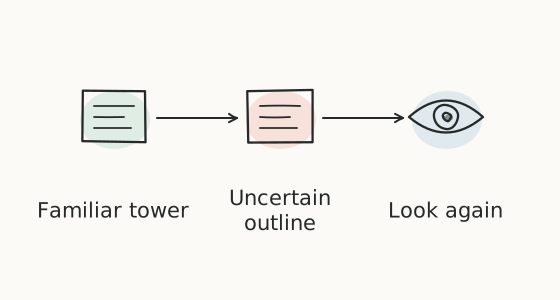
I find that our habits often work the same way. We fall into certain patterns and routines, sometimes good, sometimes bad, without really being aware of the factors that are driving our choices and actions.
Just as Dean Hovey couldn't draw the tower without first being aware of it, you and I need to be aware of the decisions and actions we are taking on a daily basis before we can understand how to change them.
Awareness is a useful first step for building good habits and breaking bad ones. Without awareness, even the most intelligent and talented people can struggle to make the decisions they want to make consistently.
This may have you wondering: what can you do to raise your level of awareness? How can you change a habit if you're not aware of it in the first place?
Here is one tactic: measure something.
To build better habits, measure something
Make an active effort to track what you're doing and how you're doing it.
This is much simpler than you might think. Here are a few examples.
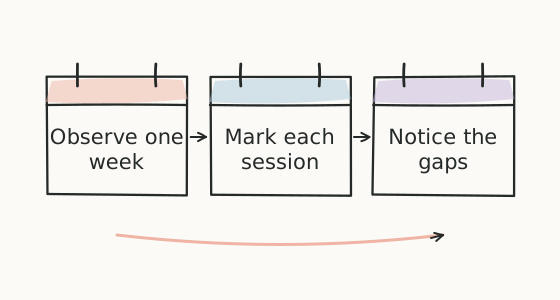
Exercise: begin by tracking your workouts. Write down how many days you train each week and what you do when you get there. If you're working on pushups, write down the sets and repetitions. That simple action can prompt you to look at the rest of your training with a more watchful eye.
You may discover that “I train regularly” means something different from what you had in mind. Perhaps travel keeps interrupting the routine, or a particular day is consistently difficult. Writing it down gives you something specific to look at.
Writing: imagine that you think you are writing consistently. You decide to measure your writing output and realize that you are unpredictable and erratic. You write when you feel motivated or inspired, which turns out to be about once every three weeks.
After becoming aware of that inconsistency, you could decide to set up a regular writing schedule. Monday and Thursday, for example. Then you can see what happens when the work has a place in the week. The record helped you discover something that your general impression had missed.
Money and business: John D. Rockefeller was known for keeping detailed accounts. The same basic practice can make your own finances easier to understand.
Track what comes in and what goes out. You may discover a handful of places where you could cut costs, a recurring payment you had forgotten, or something you would like to understand better. Increased attention can lead you to questions you had previously thought very little about.
Notice that in each example, you can start by becoming more aware of your behavior. You track and measure. By paying attention to what you are doing and how you are spending your time, ideas for improving your habits can present themselves.
Pick something that is important to you and make an effort to be more aware of the things that drive your decisions and actions. A simple record for a week can be enough to begin. You don't have to judge every entry. Write down what happened, including the days that went differently from what you expected.
If you recognize how you're spending your time, the next step will often become clearer. A workout you keep missing might need a different time. A writing session that goes well might be worth repeating under similar conditions.