How to Create a Chain Reaction of Good Habits
Human behaviors are often tied to one another.
For example, consider the case of a woman named Jennifer Dukes Lee. For two and a half decades during her adult life, starting when she left for college and extending into her forties, Lee never made her bed except for when her mother or guests dropped by the house.
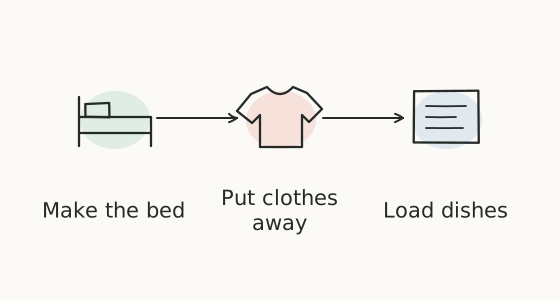
At some point, she decided to give it another try and managed to make her bed four days in a row, a seemingly trivial feat. However, on the morning of that fourth day, when she finished making the bed, she also picked up a sock and folded a few clothes lying around the bedroom. Next, she found herself in the kitchen, pulling the dirty dishes out of the sink and loading them into the dishwasher, then reorganizing the Tupperware in a cupboard and placing an ornamental pig on the counter as a centerpiece.
She later explained, “My act of bed-making had set off a chain of small household tasks... I felt like a grown-up, a happy, legit grown-up with a made bed, a clean sink, one decluttered cupboard, and a pig on the counter. I felt like a woman who had miraculously pulled herself up from the energy-sucking Bermuda Triangle of Household Chaos.”
She was experiencing the domino effect.
What is the domino effect?
The domino effect is what happens when a change to one behavior activates a chain reaction in related behaviors.
For example, a 2012 study from researchers at Northwestern University found that participants asked to increase their fruit and vegetable intake and decrease their sedentary leisure time also reduced their saturated fat intake. Reducing saturated fat was not one of that group's assigned goals. The program included coaching, self-monitoring, and incentives. The researchers suggested that less leisure time with screens might also mean fewer occasions for snacking.
You may notice similar patterns in your own life. Going to the gym might help you feel more focused at work or sleep more soundly at night, even though you never made a separate plan to improve either behavior.
The domino effect holds for negative habits as well. You may find that the habit of checking your phone leads to the habit of clicking social media notifications, which leads to the habit of browsing social media mindlessly, which leads to another twenty minutes of procrastination.
In the words of Stanford researcher BJ Fogg, “You can never change just one behavior. Our behaviors are interconnected, so when you change one behavior, other behaviors also shift.”
Inside the domino effect
As best I can tell, there are two useful explanations for the domino effect.
First, many of the habits and routines that make up our daily lives are related to one another. This is one reason why choices in one area of life can lead to surprising results in other areas, regardless of the plans you make.
Second, the domino effect can draw on commitment and consistency. This idea is explored in Influence by Robert Cialdini. If people commit to an idea or goal, even in a very small way, they may be more likely to honor that commitment because they now see that idea or goal as being aligned with their self-image.
Returning to the story from the beginning, once Jennifer Dukes Lee began making her bed each day she was making a small commitment to the idea of, “I am the type of person who maintains a clean and organized home.” After a few days, she began to act on that idea in other areas of her home.
This is an interesting byproduct of the domino effect. A cascade of new behaviors can also lead to a shift in personal beliefs. As each tiny domino falls, you start believing new things about yourself.
The rules of the domino effect
You can encourage a chain reaction by building new behaviors that naturally lead to the next action.
Here are three ways to approach it.
Start with the thing you are most motivated to do. Start with a small behavior and do it consistently. Finishing can feel satisfying and give you a chance to see what you are able to do. The first domino can be something as ordinary as making the bed.
Maintain momentum and immediately move to the next task you are motivated to finish. Let the momentum of finishing one task carry you into the next behavior. Lee picked up a sock and folded a few clothes. She was already in the room, and the next action was close by.
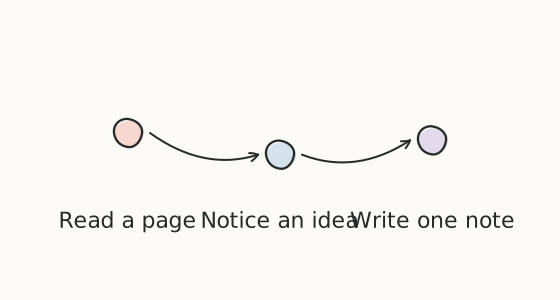
When in doubt, break things down into smaller chunks. As you try new habits, focus on keeping them small and manageable. Give the process a chance to repeat as one action leads to another.
When one habit fails to lead to the next behavior, look at the gap. The next task may be too large, too far away, or something you don't especially want to do. There are many different paths to getting dominoes to fall. Picking up a few clothes is a more manageable next step than deciding the entire house needs to be cleaned.