The Scientific Argument for Mastering One Thing at a Time
Many people, myself included, have multiple areas of life they would like to improve. For example, I would like to reach more people with my writing, to lift heavier weights at the gym, and to practice mindfulness more consistently. Those are just a few of the goals I find desirable and you probably have a long list yourself.
The problem is, even if we are committed to working hard on our goals, we tend to revert to our old habits at some point. Making a permanent lifestyle change is really difficult.
There are a few findings from habit research that may make these changes a little easier. They give us a reason to be careful about how many new things we ask ourselves to do at once.
Too many good intentions
If you want to master multiple habits and stick to them, then you need to figure out how to be consistent. How can you do that?
One useful place to begin is making a specific plan for when, where, and how you will perform the behavior. For example, in one study scientists asked people to fill out this sentence:
“During the next week, I will partake in at least 20 minutes of vigorous exercise on [DAY] at [TIME OF DAY] at/in [PLACE].”
Researchers found that people who filled out this sentence were roughly two to three times as likely to exercise compared with the groups who did not make plans for their future behavior. Psychologists call these specific plans “implementation intentions” because they state when, where, and how you intend to implement a particular behavior.
Implementation intentions have been studied across a broad range of areas, including exercise, recycling, and studying. The useful part of the plan is how little it leaves to figure out later. You know when you intend to do the thing, where you will be, and what you will actually do.
There is a complication, though. A detailed plan can still compete with six other detailed plans.
If I decide to meditate, start a demanding exercise program, cook every meal, write every morning, and learn an instrument in the same week, each activity may be worthwhile. The collection of them may be unrealistic. There are only so many moments in a day when I can keep asking myself to do something unfamiliar.

Focusing on one new habit gives you a chance to notice what is actually getting in the way. Is the time wrong? Are you trying to do too much? Do you keep forgetting? You can work on the particular problem you encounter. With five new routines going badly, it's harder to tell.
What happens with repetition
When you begin practicing a new habit it requires a lot of conscious effort to remember to do it. After a while, however, the pattern of behavior becomes easier. Your new habit becomes a normal routine and the process can become more automatic.
Researchers have a fancy term for this process called “automaticity.” Automaticity is the ability to perform a behavior without thinking about each step.
It develops through repetition and practice. The more often you repeat a behavior in a familiar situation, the less you may need to consciously manage it.
Think about a ten-minute walk after breakfast. At first, you may need a reminder. You finish eating, start looking at your phone, and then remember that you had planned to go outside. After repeating the same sequence, finishing breakfast can begin to bring the walk to mind on its own. The shoes are there. You know the route. There is less to arrange.
The time it takes to build a habit depends on many things, including how difficult the habit is and what your environment is like. A routine that depends on a very specific schedule may take more effort when your schedule changes.
One habit-formation study estimated a median of about 66 days for the behaviors it examined to approach a high level of automaticity. That was a modelled estimate. (Don't put too much stock in that number. The range in the study was very wide.) The useful expectation is that a new routine may need weeks or months of practice.
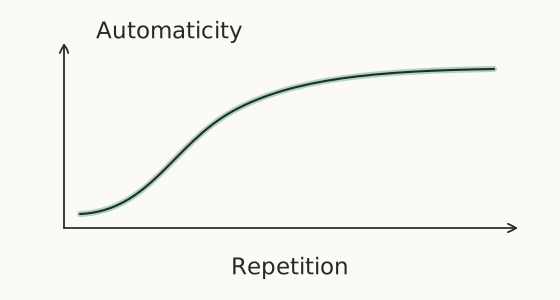
There is a period when the new habit still needs attention. If I keep introducing new commitments during that period, I keep adding to the amount I have to consciously manage.
Giving one change some room
Work on one specific habit until it becomes a familiar part of your daily life. Then repeat the process for the next habit.
This still takes some judgment. The rest of life carries on while you are learning something new. You may have to change the time, make the habit smaller, or move it to a place where you remember it more easily.
Suppose the habit is reading after breakfast. Put the book where you'll see it and choose an amount of time that fits. For the next few weeks, pay attention to that part of the day. Once it has become familiar, you can decide where to put the next thing.