The Simple Equation Behind Our Habits
In 1936, Kurt Lewin wrote a simple equation that became an influential way to think about human behavior.
B = f(P, E).
Behavior is a function of the person and their environment.
Known as Lewin's equation, this tiny expression gives us two places to look when we want to understand a habit. We can look at the person, and we can look at the situation in which the action happens.
What drives our behavior?
It is easy to explain our habits through the kind of person we think we are.
If you struggle to stick to something, you might say, “I just don't have any willpower.” If you can't seem to finish that big project, like writing a book, you might say, “I'm a great starter, but a lousy finisher.”
These descriptions can begin to sound permanent. We treat a repeated difficulty as though it tells us everything we need to know about ourselves.
Lewin's equation gives the environment a place in the explanation. Your habits depend on context. The options around you, the people you are with, the arrangement of the room, and the demands on your attention all influence what you do.
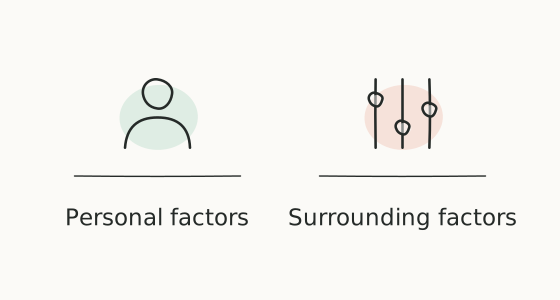
Let's break down these two areas and look at how each can help us understand a behavior.
The person
Our abilities can develop. We learn, practice, receive feedback, and find ways to do things we once found difficult.
Psychologist Carol Dweck describes the difference between a fixed mindset and a growth mindset. With a fixed mindset, you tend to see your abilities in a particular area as fixed. With a growth mindset, you believe that you can learn and build upon your current abilities.
One detail I find interesting is that the same person can have a growth mindset in one area and a fixed mindset in another. You may be willing to struggle through a difficult piece of music because you expect practice to help, then describe yourself as hopeless at something else after a few awkward attempts.
These beliefs affect what we are willing to attempt and how we interpret difficulty. Practice gives us new experiences to work with. As our skills develop, we can revise what we believe we are capable of doing.
The environment
The second factor in Lewin's equation can seem like something that happens to us. It can be difficult to change where you work, who you're surrounded by, and where you live. There are still quite a few smaller adjustments we can make.
First, you can do what BJ Fogg calls “designing for laziness.” Fogg wanted to reduce the amount of popcorn he ate, so he took the bag of popcorn out of his kitchen, climbed a ladder in his garage, and put the popcorn on the highest shelf.
If he really wanted popcorn, he could go to the garage, get the ladder, and climb up to get it. On an evening when he felt lazy, that was a lot to arrange for a snack. Moving the popcorn changed the effort involved in eating it.
Second, the physical space you live in and the arrangement of the things you come across can alter your behavior. In Nudge, Richard Thaler and Cass Sunstein discuss how the presentation of a choice influences what people select. Products at eye level in a shop have a different chance of being noticed from products down by the floor.
The same principle can appear in a form. Researchers Eric Johnson and Daniel Goldstein studied choices about organ donation. In an online experiment, people were much more likely to agree to donation when being a donor was the default than when they had to opt in. Changing the default changed the decision many people made.
Massachusetts General Hospital in Boston studied a related idea in its cafeteria. Researchers first introduced color-coded labels, then changed the placement of food and drinks. Making water and other selected drinks more visible and convenient was associated with further changes in what people bought.
This is often called choice architecture: the way options are presented and arranged. The arrangement is part of the decision, even when we barely notice it.
Third, we have the digital environment. There are a wide range of digital triggers that prompt our behavior. When an app notifies you of a new action, you're prompted to open it. When someone emails you, you are prompted to respond.
These are simple ways of encouraging repeated use of a product. They can also pull you away from the work you meant to do. As much as possible, I prefer to simplify the things asking for my attention. Turning off an unnecessary notification or leaving the phone in another room changes what interrupts the next hour.
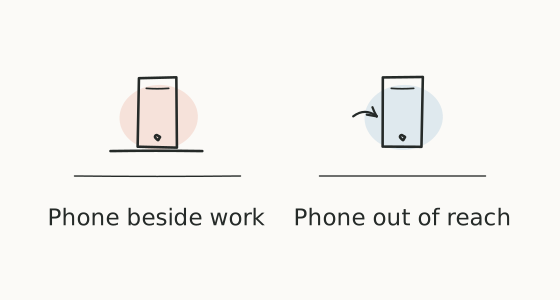
Looking at both
Changing a habit can be hard. The equation gives you a way to investigate the difficulty.
Suppose you sit down to write and keep reaching for your phone. You can look at the writing itself: whether you know what you want to say, whether you have the material you need, whether you need more practice with this kind of piece. You can also move the phone.