The Difference Between Professionals and Amateurs
I've started to notice (partially because of my own failures) how valuable it is to be able to return to a piece of work when the excitement has worn off.
Most of us know how to begin when we are interested. A new idea arrives and suddenly it is easy to find an hour. The difficulty is making time for the work on an ordinary day.
Every day at 8 a.m.
There is a useful exchange with the author Todd Henry about this. A writer explains that he does his best work when he gets a spark of creativity or inspiration. The spark only comes every now and then. He is mostly writing when he feels like it, which means he is inconsistent. He worries that writing all the time will mean putting out work that falls short of his best.
Henry's reply: “That's cool. I only write when I'm motivated too. I just happened to be motivated every day at 8 a.m.”
The ability to show up, stick to a schedule, and do the work is valuable in almost any craft. Writing regularly gives you more experience with sentences. Taking the camera out gives you more chances to notice what makes a photograph work. Practicing a movement makes it more familiar.
It sounds simple. Why is it so difficult? Because the repeated work includes plenty of sessions that feel ordinary, awkward, or frustrating.
The difficult part of being a pro
We all have goals we would like to achieve and things we would like to make. There will be days when we feel like quitting. When you start a business, there will be days when you don't feel like showing up. When you're at the gym, there will be sets you don't feel like finishing. When it's time to write, there will be days you don't feel like typing.
A professional approach gives the work a place during those days. You have decided it matters enough to return to.
That decision needs to fit your actual circumstances. A schedule that depends on ignoring every other responsibility is going to be difficult to keep. So is one that assumes every session will be your best. The useful commitment is to an amount of work you can regularly make room for.
For me, this is about making time for the things I keep saying matter to me. Writing, music, making things. They are easy to leave until the rest of the day is finished. By then, there may be very little day left.
How to approach the work
There are three practical steps.
- Decide what you want to be good at.
This sounds simple. In my experience, even people who are smart, creative, and talented can have a vague idea of what they are working toward and why. Be specific enough that you can recognize the work when you sit down to do it. If you want to write, what are you writing? Which unfinished piece could you spend time with this week?
- Set a schedule for your actions.
Once you know what you want to work on, set a schedule for actually doing it. Put an action on the calendar. “Do three sets of squats” is an action you can perform. “Spend half an hour revising the essay” is another. A desired result, such as losing a certain amount of weight or selling a certain number of copies, needs actions underneath it.
The schedule should tell you what to do when the time arrives. You can choose the size of the session with the rest of the week in mind.
- Try the schedule for one week.
It is easy to get caught thinking about how hard it will be to follow a schedule for a month or a year. Start with this week. Give the practice a few specific places in the next seven days and see what happens when you use them.
What this looks like in practice
Take pushups. Someone who wants to improve could choose Monday, Wednesday, and Friday as practice days. They can start with an amount that suits them, keep a record of what they did, and adjust it as they learn how the sessions feel. The calendar gives the intention a place to happen.
Writing can work the same way. Choose time to draft and time to revise, then give the piece a publication date. A Sunday publication means the work needs room earlier in the week. Looking at the calendar makes that easier to see.
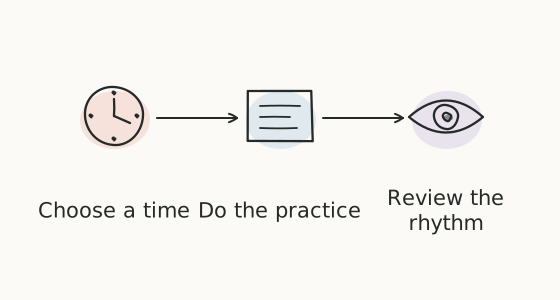
After a week, there is something concrete to review. Maybe the morning session worked and the late evening one kept disappearing. Maybe the amount was too large, or the time was right and it simply took a few minutes to settle in. Use that information when you arrange the next week.