How to Change Your Beliefs and Stick to Your Goals
The beliefs you have about yourself can drive your long-term behavior. If you keep thinking of yourself as someone who never follows through, it can be hard to give a new habit a fair chance. You are already expecting the familiar result.
There are three layers of behavior change: a change in your outcomes, a change in your processes, or a change in your identity.
Most people start by focusing on outcome-based goals like “I want to lose twenty pounds” or “I want to write a bestselling book.” Those goals describe a result. The habits you build along the way also give you evidence about the kind of person you are becoming.
This brings us to an important question: How, exactly, is your identity formed? And how can you encourage new aspects of your identity that serve you, while reconsidering the beliefs that keep getting in your way?
How to change your beliefs
Your identity develops through experience. Your habits are one of the ways you give it a recognizable form. When you make your bed each day, you have evidence that you can keep something organized. When you write each day, you have evidence that you are a person who writes. When you train regularly, you have evidence that you make time for exercise.
The more you repeat a behavior, the more you reinforce the identity associated with that behavior.
If you go to church every Sunday for twenty years, you have evidence that religious practice matters to you. If you study biology for an hour every night, you have evidence that you are studious. If you go to the gym even when it's snowing, you have evidence that you are committed to fitness. The more evidence you have for a belief, the easier it becomes to believe it.
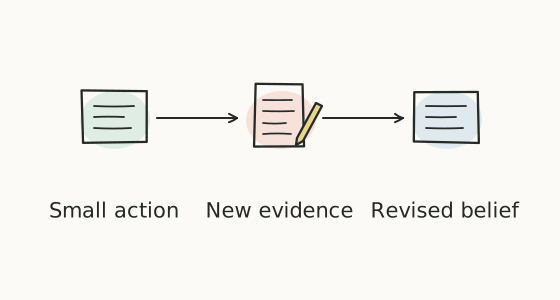
Consider someone who has never thought of themselves as a writer. They begin writing a short article every week. At first, “writer” may feel like an extravagant description of what they are doing. A few months later, there are actual articles to look at. They have worked through a difficult opening, finished a draft, come back to a sentence that bothered them. The description starts to feel more ordinary.
Habits are one source of this evidence. A single experience can also change how we see ourselves, sometimes quite sharply. Repetition has a particular advantage, though: it gives us fresh evidence again and again.
You probably wouldn't consider yourself a soccer player because you kicked a ball once or an artist because you scribbled a picture. As you repeat these actions, the evidence accumulates and your self-image can begin to change.
This is a gradual evolution. We change bit by bit, day by day, habit by habit. We are continually undergoing small revisions of the way we see ourselves.
If you finish a book, then perhaps you are the type of person who likes reading. If you go to the gym, then perhaps you are the type of person who likes exercise. If you practice playing the guitar, perhaps you are the type of person who likes music.
Each habit is like a suggestion: “Hey, maybe this is who I am.”
I like thinking of these actions as votes. One instance may feel small. As the votes build up, so does the evidence. Small habits can make a meaningful difference because they give you an experience you can point to when you are unsure of yourself.
- Each time you write a page, you are practicing being a writer.
- Each time you practice the violin, you are practicing being a musician.
- Each time you start a workout, you are practicing being someone who exercises.
- Each time you encourage your employees, you are practicing being a leader.
These habits can also teach you to trust yourself. You start to believe you can actually do the things you keep saying matter to you. When the evidence begins to change, the story you tell yourself can change as well.
Leaving room for an imperfect record
The voting idea is useful because an election can contain votes for both sides. You can miss a practice and still have a long record of returning to it. One difficult week deserves to be seen alongside the other weeks.
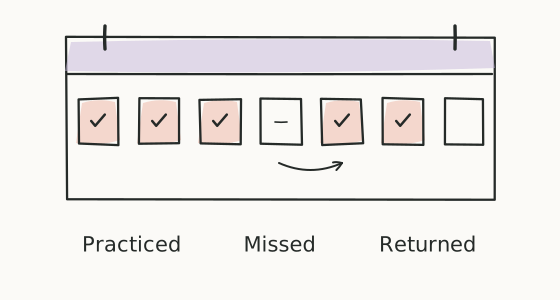
I would be careful with the opposite interpretation, where every missed day becomes evidence of a bad identity. People get tired. Plans stop fitting. Sometimes the habit needs to change. Those are things you can investigate without turning them into a verdict about yourself.
This is why I like starting with incredibly small actions (small votes still count!) and building consistency. Two minutes of writing gives you something to return to. A short practice gives you a chance to learn what makes the next one easier to arrange.