Plan for Failure: Making Room for an Imperfect Week
You probably realize that consistency is important for making progress, doing better work, getting in shape, and achieving some level of success in most areas of life.
I write about the power of consistency often: how small gains add up, why repetition matters, and what happens when we keep practicing after the early excitement wears off.
Once you realize the power of consistency, there is a danger that comes with this knowledge. And that danger is falling into an all-or-nothing mindset.
As usual, I don't have this all figured out. Let's talk about how to be consistent while leaving some room for the things that happen in an actual life.
The all-or-nothing mindset
Once you realize that consistency matters, it can be easy to obsess over becoming flawlessly consistent.
For example:
- Trying to change the way you eat? It's easy to convince yourself that one unplanned meal means you've failed.
- Want to meditate each day? Beware of focusing so much on never missing a day that you stress over sticking to your meditation schedule.
- Looking to become a successful writer? You can quickly brainwash yourself into thinking that successful authors write every single day without fail. (The same goes for artists and athletes of all kinds.)
It's really easy to confuse being consistent with being perfect. That leaves no safety margin for errors, mistakes, and emergencies. (You know, the type of things that make you a normal human being.)
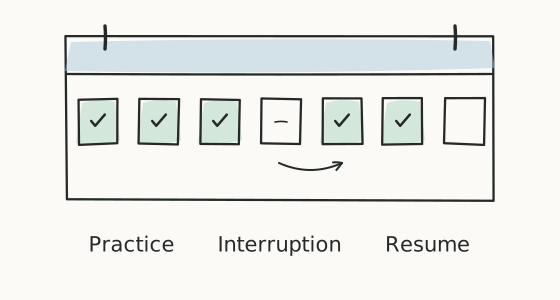
Cutting yourself some slack becomes even more reasonable when we look at habit formation. In one study, missing a single opportunity to perform a behavior did not materially affect the habit formation process. The repeated practice still counted.
A missed day can be like a red light during a road trip. When you're driving a car, you'll come to a red light every now and then. The stop is part of the trip. When the light changes, you continue from where you are.
The idea in practice
Coach Josh Hillis offers a useful example of looking at a longer stretch of time. In his writing about food habits, he asks people to look at where things came apart, figure out the practical issue, and choose one small step that would make the next week easier.
Maybe the problem was planning. Maybe it was having time to shop or cook. Looking across the week gives you a chance to see the pattern. A single meal gives you much less information about how the routine is working.
I find this to be an empowering way to think about consistency and progress in nearly any area. I have given myself permission to view my progress over a longer timeline than a single day or an individual event.
If you write three times during a busy week, you have three sessions to learn from. If you were hoping for four, it is worth looking at what happened to the fourth. The other three still exist.
Plan for the interruption
Mastery requires a volume of work. It also takes time, which means that the practice has to fit through changing circumstances.
A plan for an interruption tells you what you will do and how you will get back to the routine when things go differently from what you expected. You can make that decision while you have a little room to think.
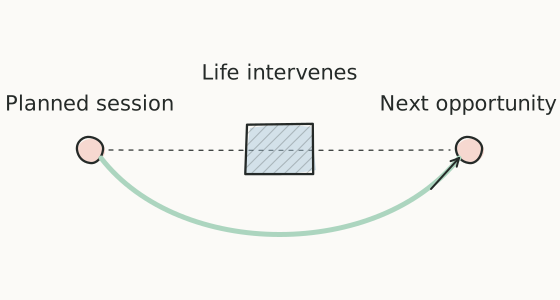
Suppose Tuesday is usually a writing morning. If something takes that time, where is the next opportunity? You could put a short session on Wednesday, or return at the next regularly scheduled time. Either gives you a concrete way back.
The same goes for the size of the session. On a crowded day, you might have time to read through a paragraph and leave a note about what you want to work on next. That can make returning easier when you have more time.
If the same interruption keeps happening, the schedule may need to change. You can look at the week you actually have and move the practice somewhere it fits.