How to Be Motivated Every Day: Lessons Learned from Twyla Tharp
Twyla Tharp was born in Indiana and was named after the local “Pig Princess” at the Annual Muncie Fair, who went by Twila.
She is widely regarded as one of the greatest dancers and choreographers of the modern era. She has choreographed dances for the Paris Opera Ballet, The Royal Ballet, New York City Ballet, Boston Ballet, and many others. Her work has appeared on Broadway, on television, and in films. In 1992, she was awarded a MacArthur Fellowship.
Twyla Tharp is prolific. The question is, how does she do it?
The power of ritual
In The Creative Habit, Tharp discusses one part of her routine:
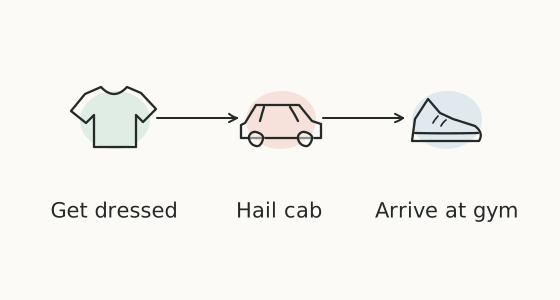
“I begin each day of my life with a ritual,” she writes. “I wake up at 5:30 A.M., put on my workout clothes, my leg warmers, my sweatshirts, and my hat. I walk outside my Manhattan home, hail a taxi, and tell the driver to take me to the Pumping Iron gym at 91st street and First Avenue, where I work out for two hours.”
For Tharp, the ritual is the cab. “The moment I tell the driver where to go I have completed the ritual.”
Doing it the same way each morning makes the beginning familiar and repeatable. As she writes, “It is one more item in my arsenal of routines, and one less thing to think about.”
Let's talk about what makes Tharp's morning routine so important and how we can use it to build our own habits.
Motivation often follows the beginning
If you have trouble sticking to a habit, it can be easy to assume that you need to learn how to get motivated.
Motivation often comes after starting a behavior. Getting started gives you something to respond to and can produce a little momentum.
You have probably experienced this phenomenon before. For example, going for a run may seem overwhelming or exhausting just to think about before you begin, but if you can muster up the energy to start jogging, you'll often find that you become more motivated to finish as you go. In other words, it's easier to finish the run than it was to start it in the first place.
It brings to mind Newton's first law: objects in motion tend to stay in motion. That is a useful analogy for the momentum of getting started.
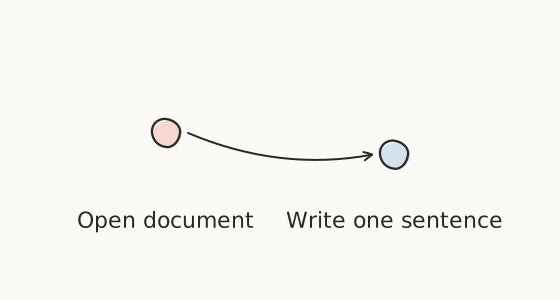
Writing offers another example. A blank page can feel overwhelming. Once there are sentences on it, you have something to work with. You can revise a phrase, follow a thought, and find the next paragraph.
And this is where Tharp's morning routine comes back into the picture.
A familiar way into the behavior
The power of a ritual, or what I like to call a pre-game routine, is that it provides a familiar way to initiate your behavior. It makes starting your habits easier and that means following through on a consistent basis is easier.
Habit researcher Benjamin Gardner has used the example of a bicycle commuter to explain how a habitual action can begin a longer, more complex sequence. The commuter may put on a helmet automatically. Negotiating the journey still requires attention and judgment.
Getting started with a simple ritual, such as putting on the helmet or checking the air in the tires, gets the person into the larger activity. The beginning can be familiar even when the rest of the task asks you to think.
Twyla Tharp's morning routine is a useful example of this idea in practice. Naturally, there are going to be days when she doesn't feel like getting out of bed and exercising. There are bound to be times when the thought of starting the day with a two-hour workout seems exhausting. Her ritual of waking up and hailing the taxi gives her a familiar beginning.
She has fewer decisions to make about what to do next. She doesn't have a debate with herself about what the first step should be. She simply follows the same pattern that she always does.
And once the pattern is in motion, the rest of the sequence follows more easily.
A good ritual removes some of the decisions: What should I do first? When should I do this? How should I do this? Having a ritual takes that burden off your shoulders.
The idea in practice
Here are some ways to apply the same idea:
- Exercise more consistently: use the same warmup routine in the gym.
- Make room for creative work: follow a simple ritual before writing, painting, or singing.
- Begin the day with a pause: choose a familiar time for five minutes of meditation.
- Prepare for sleep: follow a power-down routine before bed.
Whatever it is, make it your own. Use your ritual as an on-ramp for the bigger behavior and habits you want to build into your life. A familiar beginning gives you something to do on the days when motivation is low.