Setting Goals and Building the Systems to Follow Through
Prevailing wisdom claims that the best way to achieve what we want in life is to set specific, actionable goals. Getting into better shape, building a successful business, relaxing more and worrying less, spending more time with friends and family. We decide what we want and make it a goal.
It is easy to approach every habit this way. A grade to reach. A weight to lift. An amount of money to earn. The goal tells us where we hope to arrive. We also need to look at the repeated actions that could take us there.
- If you're a coach, your goal might be to win a championship. Your system is the way you recruit players, manage your assistant coaches, and conduct practice.
- If you're an entrepreneur, your goal might be to build a million-dollar business. Your system is how you test product ideas, hire employees, and run marketing campaigns.
- If you're a musician, your goal might be to play a new piece. Your system is how often you practice, how you break down and tackle difficult measures, and your method for receiving feedback from your instructor.
Now for the interesting question: if you spent less time thinking about the goal and more time improving the system, would you still get results? For example, if you were a basketball coach and focused on what your team does at practice each day, would that help you win games?
I think it would.
It would be ridiculous to spend the whole game staring at the scoreboard. You have to play. The score gives you information about what is happening, and there is work to do on the court.
Goals are useful for setting a direction. Systems give you a way to make progress. A handful of problems arise when you spend a lot of time thinking about the first and very little time working on the second.

Winners and losers can have the same goal
Goal setting suffers from a serious case of survivorship bias. We concentrate on the people who end up winning and assume that ambitious goals led to their success. We overlook the people who had the same objective and fell short.
Many Olympians want to win a gold medal. Every candidate in an interview process may want the job. Sharing the goal tells us very little about what distinguishes their preparation, circumstances, or performance.
Consider a professional cycling team. Wanting to win the Tour de France is familiar. The goal may have been there for years. What changes between seasons is the preparation: how the riders train, how equipment is maintained, how recovery is arranged, what the team learns from the last race. Those are things the team can examine and improve.
Achieving a goal can be a momentary change
Imagine you have a messy room and you set a goal to clean it. If you summon the energy to tidy up, then you will have a clean room for now. If the habits that created the clutter stay the same, soon you'll be looking at a new pile and hoping for another burst of motivation.
You are left chasing the same outcome because the arrangement behind it keeps producing the same problem.
Where does the mail go when it comes through the door? Where do you put the clothes you have taken off? Is there somewhere convenient to return the things you use? Those details affect what the room will look like next week.
A clean room is a useful result. Changing the routines around it can make that result easier to keep.
A goal can keep postponing your satisfaction
It is easy to slip into the assumption, “Once I reach my goal, then I'll be happy.” The next milestone becomes the place where you imagine you will finally relax.
I've slipped into this trap. There is always another thing that could be finished first. Another version of the work that would make it feel acceptable to stop for the day.
Goals can also create an either-or conflict: you achieve the exact result and feel successful, or fall short and feel like a disappointment. You mentally box yourself into a narrow version of happiness.
It is unlikely that your actual path through life will match the exact journey you had in mind when you set out. There may be several ways to make work you care about or build a life you enjoy. A plan made at one moment should have room for what you learn along the way.
Paying attention to the process gives you more places to find satisfaction. You can enjoy working through a difficult section of music, making something useful, or having a good practice with the team. These experiences happen while the larger goal is still unfinished.
What happens after the finish line?
A goal-oriented approach can create a yo-yo effect. A runner works hard for months, crosses the finish line, and then stops training. The race is no longer there to organize the week.
When all of your hard work is focused on a particular goal, what remains after you achieve it? Often, you need to decide what part of the activity you want to keep doing.
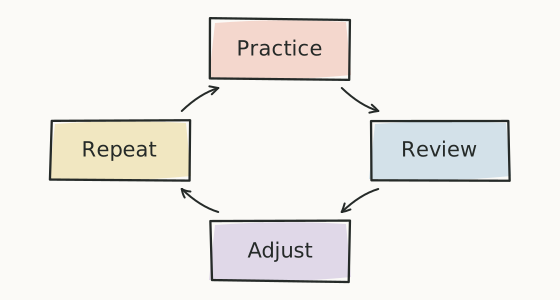
You may want a different amount of it. After a demanding race, the next routine might be a few relaxed runs with friends. After finishing a large project, you might keep a small block of time for experimenting with the next idea. The rhythm can change with the circumstances.
That is one reason I find it useful to think about systems. There is something to return to, look at, and adjust. You can ask how the practice is working, what you are learning, and whether the original goal still makes sense.
For the musician, that might mean noticing that the difficult measures need slower practice. For the coach, it might mean changing one part of training after watching a game.