Identity-Based Habits: How to Actually Stick to Your Goals This Year
Change is hard. You've probably noticed that.
We all want to become better people: stronger and healthier, more creative and more skilled, a better friend or family member.
Even if we get really inspired and start doing things better, it's tough to actually stick to new behaviors. A few weeks later, we can find ourselves doing something familiar again.
Why is that? Part of it has to do with the things we already believe about ourselves.
How to be good at remembering people's names
Consider this classroom story. It is the first day of class at a large high school. Many of the students have never met before that day. The teacher goes around the room and asks each person to introduce themselves. At the end, the teacher asks if anyone can remember everyone's name.
One student raises her hand and proceeds to go around the room and accurately name all thirty or so people. The rest of the room is stunned. The guy next to her looks over and says, “I couldn't even remember your name.”
You can imagine how affirming that moment would be. “I'm the type of person who is good at remembering people's names.” She has a specific experience to support that belief.
This is what makes the story useful: to believe in a new identity, we need some evidence for it.
Identity-based habits
The way we see ourselves can influence which actions we attempt and how we interpret the results. Sometimes a new habit has to make its way through a description we've been using for years: I'm forgetful. I'm bad at finishing things. I'm just not that kind of person.
Building a habit gives us a way to start believing something new about ourselves.
Imagine how we typically set goals. We might start by saying, “I want to lose weight” or “I want to get stronger.” Someone might suggest that we be more specific. So then we say, “I want to lose twenty pounds” or “I want to squat three hundred pounds.”
These goals are centered around outcomes. To understand where identity fits, consider that there are three levels at which change can occur. You can imagine them like the layers of an onion.
The first layer is changing your outcomes. This level is concerned with changing your results: losing weight, publishing a book, winning a championship. Most of the goals you set are associated with this level of change.
The second layer is changing your process. This level is concerned with changing your habits and systems: implementing a new routine at the gym, decluttering your desk for better workflow, developing a meditation practice. Most of the habits you build are associated with this level.
The third layer is changing your identity. This level is concerned with changing your beliefs: your worldview, your self-image, your judgments about yourself and others. The beliefs and assumptions you hold are associated with this level.
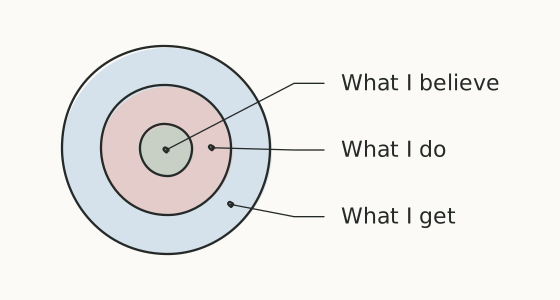
All three levels are useful. They also affect one another. A result can change what you believe. A belief can influence which actions you attempt. A repeated action can make a new belief feel more plausible.
Many people begin the process of changing their habits by focusing on what they want to achieve. With identity-based habits, we also ask who we wish to become.
Proving it to yourself
There are two steps:
- Decide the type of person you want to be.
- Prove it to yourself with small wins.
First, decide who you want to be. What do you want to stand for? What are your principles and values? Who do you wish to become?
These are big questions, and many people aren't sure where to begin. They may already know the kind of result they want: to become stronger, to finish a piece of writing, to have more time with friends. That's fine. Start there and work backward from the result to the actions that would support it. Ask yourself, “What would someone working toward this do in an ordinary week?”
Here are five examples of how you can make this work in real life.
Want to move more? Become the type of person who makes time to move each day. A small win could be walking fifty extra steps when you get home from work. Increase the amount as it becomes comfortable. The first walk can be very short.
Want to become a better writer? Become the type of person who writes regularly. A small win: write one paragraph each day this week. Now you have a paragraph you actually wrote, something you can come back to and work on.
Want to become strong? Become the type of person who trains regularly. Choose a manageable exercise routine and give it a place in the week, perhaps Monday, Wednesday, and Friday. The identity should leave room for returning after a missed session.
Want to be a better friend? Become the type of person who stays in touch. A small win: call one friend every Saturday. If you rotate through a dozen people, you can speak with each of them every few months. That is a lot of old friendships to keep up with through one weekly call.
Want to be dependable at work? Become the type of person who arrives on time. A small win: schedule meetings with an additional fifteen-minute gap between them so that you can get from one meeting to the next without rushing.
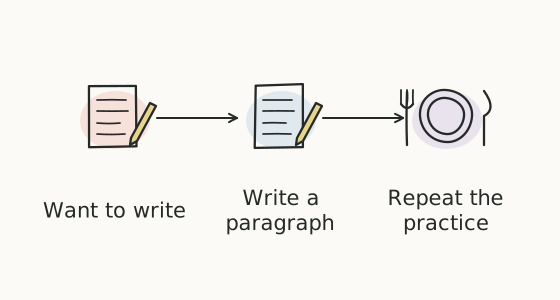
In my experience, proving something to yourself matters a lot in the beginning. It gives you an actual experience to remember the next time you wonder whether you can do it.
Writing is one place where I can see this. I have notes, old projects, and unfinished pieces that already contain years of thought. There is a body of work there that deserves some attention. I can sit down with one of those pieces, read what I was trying to say, and keep working on it.