How to Stop Procrastinating With Temptation Bundling
Ronan Byrne, an electrical engineering student in Dublin, Ireland, enjoyed watching Netflix. He also knew that he should exercise more often than he did.
Putting his engineering skills to use, Byrne hacked his stationary bike and connected it to his laptop and television. Then he wrote a computer program that would allow Netflix to run only if he was cycling at a certain speed. If he slowed down for too long, whatever show he was watching would pause until he started pedaling again.
He was employing temptation bundling to make his exercise habit more attractive. Temptation bundling works by linking an action you want to do with an action you need to do. In Byrne's case, he bundled watching Netflix (the thing he wanted to do) with riding his stationary bike (the thing he needed to do).
Businesses are masters at temptation bundling. For instance, when ABC launched its Thursday night television lineup for the 2014–2015 season, it promoted temptation bundling on a massive scale.
Every Thursday, the company would air three shows created by screenwriter Shonda Rhimes: Grey's Anatomy, Scandal, and How to Get Away with Murder. They branded it as “TGIT on ABC” (TGIT stands for Thank God It's Thursday). In addition to promoting the shows, ABC encouraged viewers to make popcorn, drink red wine, and enjoy the evening.
Andrew Kubitz, head of scheduling for ABC, described the idea behind the campaign: “We see Thursday night as a viewership opportunity, with either couples or women by themselves who want to sit down and escape and have fun and drink their red wine and have some popcorn.” ABC was associating the thing it needed viewers to do (watch its shows) with activities those viewers already wanted to do (relax, drink wine, and eat popcorn).
If you drink red wine and eat popcorn at 8 p.m. every Thursday, then eventually “8 p.m. on Thursday” can begin to mean relaxation and entertainment. The reward gets associated with the cue, and the habit of turning on the television becomes more attractive.
You're more likely to find a behavior attractive if you get to do one of your favorite things at the same time.
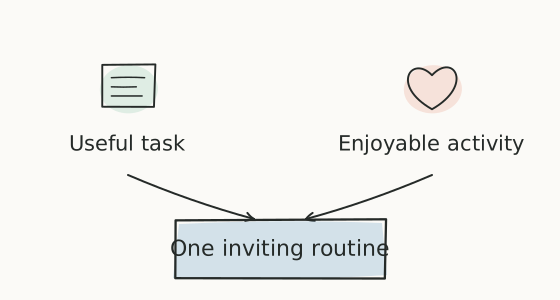
Finding a combination that works
Perhaps you want to hear about the latest celebrity gossip and you also want to exercise more often. Using temptation bundling, you could save the tabloids and reality shows for the exercise bike. Maybe you want to get a pedicure and you need to clean out your email inbox. You could process overdue work emails during the appointment.
Temptation bundling is one way to apply a psychology theory known as Premack's principle. Named after the work of professor David Premack, the principle states that more probable behaviors can reinforce less probable behaviors. Even if you don't really want to process overdue work emails, getting to do something you enjoy along the way can give you another reason to begin.
There is a simple exercise you can use to figure out your own temptation bundling strategy. You're going to create a two-column list:
- In column one, write down the pleasures you enjoy and the temptations that you want to do.
- In column two, write down the tasks and behaviors you should be doing, but often procrastinate on.
Take your time and write down as many behaviors as possible. Then browse your list and see if you can link one of your instantly gratifying “want” behaviors with something you “should” be doing.
Here are a few common examples:
- Only listen to audiobooks or podcasts you love while exercising.
- Only get a pedicure while processing overdue work emails.
- Only watch your favorite show while ironing or doing household chores.
- Only eat at your favorite restaurant when conducting your monthly meeting with a difficult colleague.
The pairing matters. A show that keeps pulling your eyes away from the work may make the work take twice as long. A podcast can be a poor companion for writing something that requires close thought. And if a task already needs your full physical attention, adding another activity can make it awkward.
I would also leave room for pleasure that has no job attached to it. Turning every enjoyable thing into a reward you have to earn can become another way to make the day feel crowded. The useful question is whether a particular combination makes a particular task easier to return to.
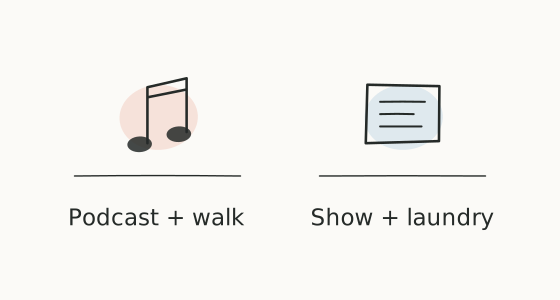
Putting the bundle into a routine
You can even combine temptation bundling with habit stacking to create a set of rules to guide your behavior. The formula is:
- After [CURRENT HABIT], I will [HABIT I NEED].
- After [HABIT I NEED], I will [HABIT I WANT].
Say you want to read the news and you also want to express more gratitude. After you get your morning coffee, say one thing you're grateful for that happened yesterday. After that, read the news.
Or suppose you want to watch sports and you need to make sales calls. After you get back from your lunch break, call three potential clients. After those three calls, check ESPN.
The hope is that eventually you'll look forward to calling three clients because it means you get to read the latest sports news. Doing the thing you need to do means you get to do the thing you want to do.
It may take some adjustment. Three calls could be the wrong amount. The reward might be too distracting to return from. A routine that looks sensible on paper can turn out to fit badly into the actual day. I think it's worth treating the first version as something to try.
The jobs that can always wait
Consider how many tasks are important to our progress and rarely feel urgent in our daily lives. Getting a workout in. Cleaning your office space or kitchen. Practicing the fundamentals of your craft.
On any one day, postponing them can feel harmless. There is usually something more immediate asking for attention. By the end of the week, the immediate things have taken all the available space again.
A useful bundle gives one of these activities something enjoyable in the present. The benefit of exercise may feel distant when you're tired after work. Wanting to hear the next chapter of a book is easier to feel right then.
That is what makes Byrne's arrangement work. When he sits down to watch the show, the bike is already part of the evening. He wants to find out what happens next, so he keeps pedaling.