The Chemistry of Building Better Habits
There is a concept in chemistry known as activation energy.
Here's how it works.
Activation energy is the energy barrier that must be overcome for a chemical reaction to occur.
Let's say you are holding a match and gently touch it to the striking strip on the side of the matchbox. Nothing happens because you haven't supplied the energy needed to start the reaction.
If you strike the match against the strip with some force, you create the friction and heat required to light it. The energy you added by striking the match was enough to start the reaction.
It's sort of like rolling a boulder up a hill. You have to add some extra energy to push the boulder to the top. Once you've reached the peak, the boulder can roll down the other side. The match gives us a useful picture of the extra effort a beginning can require.
Alright, so how is this useful in our everyday lives and in building better habits?
The effort required to start
We can think of a habit or behavior as having an activation energy as well.
This is just a metaphor, of course. Whatever habit you are trying to build, there is a certain amount of effort required to start it. The more difficult or complex a behavior, the greater the effort you may need to begin.
For example, sticking to the habit of doing one pushup per day requires very little energy to get started. Doing a hundred pushups per day is a much larger commitment. It's going to take more motivation, energy, and preparation to begin that day after day.
The smaller the habit, the less energy you need to start.
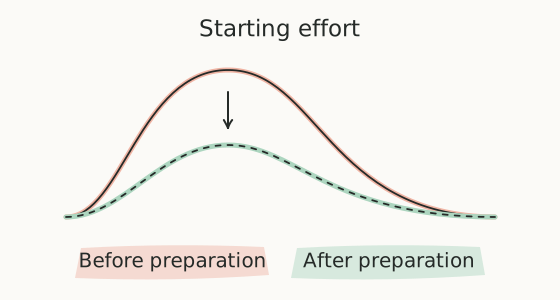
The gap between goals and habits
Here's a common problem when trying to build new habits.
It can be really easy to get motivated and hyped up about a big goal that you want to achieve. This big goal leads you to think that you need to revitalize and change your life with a new set of ambitious habits. Soon you are dreaming about a whole life-changing outcome while the daily routine has become difficult to begin.
In the beginning, you might be able to find the energy to get started each day because you're motivated and excited about your new goal. Pretty soon, that motivation starts to fade. Suddenly you're lacking the energy you need to begin the habit each day.
This is lesson one: smaller habits require less effort to start, which can make them more sustainable. When you require a lot of energy to get started, there are bound to be days when starting never happens.
Finding a catalyst for your habits
Everyone is on the lookout for tactics that can make success easier. Chemists have a useful idea for us here, too.
A catalyst is a substance that speeds up a chemical reaction by providing a pathway with a lower activation energy. It is regenerated in the reaction rather than used up overall.
When it comes to building better habits, your environment can play a similar role.
The environments where we live and work influence our behavior. How can we structure those environments to make the habits we want to keep easier to begin?
Imagine you are trying to build the habit of writing for fifteen minutes each evening after work. A noisy environment with loud roommates, rambunctious children, or constant television noise in the background can make it difficult to begin. There is a lot competing for your attention.
If you step into a quiet writing environment, like a desk at the local library, your surroundings can make it easier for the habit to proceed.
Your environment can help in big and small ways. If you set your running shoes and workout clothes out the night before, you lower the effort required to go running the next morning. If you prepare ingredients ahead of time, you make it easier to cook when you get home. If you unplug your television and put it in the closet, you add effort to the act of turning it on.
This is lesson two: the right environment can make a useful habit easier to start. You can change the arrangement before the moment when you need to act.
The steps inside the habit
Chemical reactions can proceed through intermediates, with several steps on the way to the final product. That gives us another useful analogy.
There are all sorts of intermediate steps within habits as well.
Say you want to build the habit of working out. That could involve paying for a gym membership, packing your gym bag in the morning, driving to the gym after work, exercising in front of other people, and so on.
Each step asks something of you.
When you're struggling to stick with a new habit, examine each link in the chain and figure out which one is your sticking point. Which step keeps the habit from happening?
Some of these steps might be easy for you. You might be fine with paying for a gym membership or packing your gym bag in the morning. Driving to the gym after work may be frustrating because you end up hitting more rush hour traffic. Or you may discover that you don't enjoy working out in public with strangers.
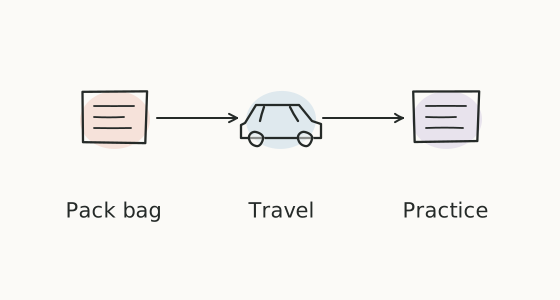
Finding a solution for the difficult step can make the whole habit easier. Perhaps going to the gym in the morning would allow you to avoid rush hour traffic. Maybe a home workout routine would let you skip the traffic and exercise in a place where you feel comfortable.
This is lesson three: examine your habits closely and see whether you can remove or change the steps that create the most difficulty.
The whole routine may look like one thing on a calendar: “work out.” Looking inside it gives you more to work with. You can leave the gym bag packed, choose a different time, or change where you exercise.