The One Word That Can Drive Senseless and Irrational Habits
In 1978, psychologist Ellen Langer and her colleagues published a study that would become a familiar example of how easily we can respond to a request without examining it.
It all started with researchers asking to cut in front of people waiting at a library photocopier.
The copy machine study
This is how the research study worked.
A researcher would spot someone at the library copy machine and walk over with the intention of cutting in line. Then, the researcher would ask one of three questions.
- Request only: “Excuse me, I have 5 pages. May I use the Xerox machine?”
- Request with a reason: “Excuse me, I have 5 pages. May I use the Xerox machine, because I'm in a rush?”
- Request with a redundant reason: “Excuse me, I have 5 pages. May I use the Xerox machine, because I have to make copies?”
You'll notice that the third version didn't make much sense. Using the phrase “because I have to make copies” was a fairly useless reason for skipping the line. Everyone waiting at the photocopier needed to make copies. The phrase contained no new information, but the researcher was trying to use it to justify the favor anyway.
Surprisingly, this senseless reason performed well.
For the five-page requests, the researchers found the following:
- Request only: 60 percent of people let the researcher go first.
- Request with “because I'm in a rush”: 94 percent agreed.
- Request with “because I have to make copies”: 93 percent agreed.
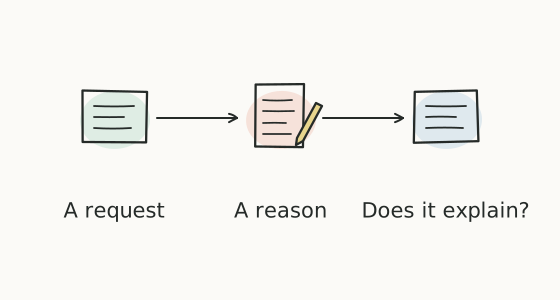
The study was published in the Journal of Personality and Social Psychology. It also tested larger, twenty-page requests. There, the redundant reason lost its advantage over giving no reason. The amount being asked of someone mattered.
The study became famous for what it suggested about the word “because.” In a small, familiar interaction, the presence of a reason could be enough for people to go along with the request, even when the reason added very little.
In Influence, Robert Cialdini explains the appeal simply: “People simply like to have reasons for what they do.”
Why we do what we do
Imagine someone who conducts a habits seminar once a year. For the last year, they have been saying, “Oh, I only run one seminar per year because people tend to build new habits at the start of the year.”
After the seminar finishes, they ask for feedback. One of the first messages says, “Suggestion: maybe offer the seminar twice a year?”
Similar feedback comes from other attendees. People want to build better habits throughout the year, and it can be easy to fall off track with your goals. Hosting a seminar more than once could give people another chance to return.
As soon as you hear the feedback, it seems logical. Yet the original schedule had a reason attached to it, so it was easy to leave it alone.
I'd venture to say that we do this to ourselves in many areas of life. We have a reason for why we can't exercise consistently, why we can't write each day, or why a project has to wait.
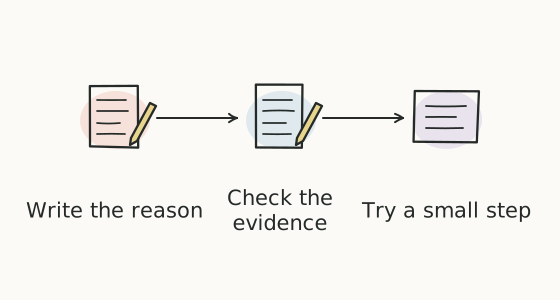
Some of those reasons are true and accurate. We all have circumstances that make now a difficult time for a particular change. We also have explanations that have become familiar enough to escape a second look.
“I need a free afternoon to write” might be true for finishing a particular essay. Reading the draft or working on one paragraph may fit into a shorter opening. It helps to be specific about what the reason actually applies to.
The reasons that guide our behavior are stories we tell ourselves about what is happening. Sometimes those stories explain the situation well. Sometimes we are repeating an explanation that no longer fits. Asking “How do I know?” gives us a chance to find out which one we are using.