5 Common Mistakes That Cause New Habits to Fail
Behavior change is hard. No doubt about it.
Why is that? What are the biggest reasons new habits fail to stick? And what can we do to make positive changes easier?
I don't claim to have all the answers, but here are some practical problems to look for.
Problem 1: trying to change everything at once
Pick one thing and do it well.
It helps to focus on changing a small number of habits at the same time. BJ Fogg's approach to practicing several habits together is built around incredibly tiny habits.
How tiny? His suggested habits include flossing one tooth, doing one pushup per day, or saying “It's going to be a great day” when you get out of bed in the morning.
Personally, I prefer to focus on building one new behavior into my life at a time. Once that habit becomes routine, then I move on to the next one. For example, you might spend several months focusing on going to the gym every Monday, Wednesday, and Friday. Once that feels like a routine, you could move on to writing regularly. Later, you might add flossing every day. And so on. You get the idea.
Still struggling? When in doubt, pick something that could potentially be a keystone habit.
A keystone habit is a behavior or routine that makes other useful behaviors easier. Exercise can work this way. Some people find that they focus better after a workout, eat better when they are working out consistently, or sleep more soundly at night. They started with one activity and found it affecting several parts of the day.
You'll have to figure out what your keystone habit is for you. Some common possibilities include exercise, meditation, or budgeting your monthly finances.
Problem 2: starting with a habit that is too big
As Leo Babauta says, “Make it so easy you can't say no.”
For many behaviors, the most difficult part of a new habit is starting. It takes a lot of motivation to head to the gym for a workout after an exhausting day at work, but once you actually begin the workout it can be much easier to continue. For this reason, one of the best things you can do for building a new behavior is to start with a remarkably small habit.
New habits should be non-threatening. Start with a behavior that is so small it seems easy and reasonable to do it each day.
Want to do fifty pushups per day? Start with something easy like five or ten, or whatever fits your current ability. Wish you would read more books? Start by reading two pages every night. Want to finally start meditating? Meditate for one minute each morning. Once that feels familiar, you can try two minutes.
Problem 3: leaving the ritual out of the goal
Nearly every conversation about goals and resolutions is focused on some type of result. What do you want to achieve? How much money do you want to save? How many books do you want to read? How much less do you want to drink?
Naturally, we are outcome focused because we want our new behaviors to deliver new results.
The next step is to build a routine that can produce those results. A lifestyle is a process. It helps to give your attention to the repeated actions that make up that process.
Rituals are what turn behaviors into habits. In the words of Tony Schwartz, “A ritual is a highly precise behavior you do at a specific time so that it becomes automatic over time and no longer requires much conscious intention or energy.”
If you want to read more, choose when you will open the book. If you want to save money, choose when you will look at your finances. Give the action a place in the day.
Problem 4: not changing your environment
Build an environment that makes the habit easier.
It is difficult to change what you eat if you are constantly surrounded by food you are trying to eat less often. It is difficult to focus on a single task if you are constantly bombarded with text messages, notifications, emails, questions, and other digital distractions.
We rarely admit it (or even realize it), but our behaviors are often a response to the environment we find ourselves in.
For example, let's say that your New Year's resolution is to reduce stress in your life and live in a more focused manner.
Here is the current situation.
Every morning, the alarm on your phone goes off. You pick up the phone, turn off the alarm, and immediately start checking email and social media. Before you have even made it out of bed, you are already thinking about half a dozen new emails. Maybe you've already responded to a few. You also browsed the latest updates on social media, so those messages and headlines are swimming around in your mind too. You haven't even dressed yet, but your mind is already distracted and stressed.
If this scene sounds familiar and you want to change your habit, then a useful place to begin is your environment. Don't keep your phone beside the bed.
Buy a regular alarm clock (shockingly old school, I know) and charge your phone in another room (or, at least, across the room away from your bed).
You can change the digital environment too. Turn off notifications you don't need. You can even remove your email and social media apps from the home screen and hide them somewhere else on the phone. Try taking an app off the phone for a while and see how much you miss it.
Problem 5: assuming small changes don't add up
If you listen to nearly anyone talk about their goals, you'll hear them describe the minimum that they want to achieve.
- “I want to save at least $5,000 this year.”
- “I want to read at least thirty books this year.”
- “I want to work out at least five days a week.”
The underlying assumption is that your achievements need to be big to make a difference. Because of this, we talk ourselves into chasing a big habit. A wish to get stronger becomes, “I need to start busting my butt and working out for ninety minutes a day!”
If you look at your current habits, however, you'll see a different picture. Many of the habits you have today, good or bad, are the result of small choices made over time. It is the repeated pattern of small behaviors that leads to significant results.
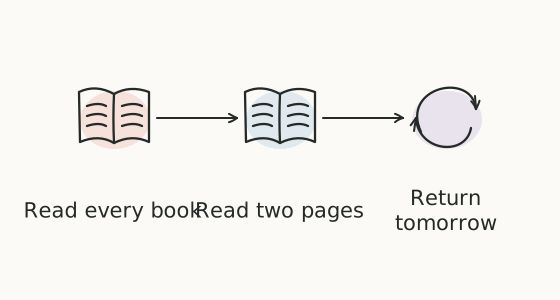
If you're serious about building a new habit, then start with something small. Start with something you can stick with. Then, once you've repeated it enough times to see how it fits, you can think about increasing the intensity.