How to Declutter Your Mind by Using Bright-Line Rules
“You have the right to remain silent.”
Most of us have heard those words enough times to recognize what comes next. The familiar warning grew out of a case involving Ernesto Miranda, who was arrested in Phoenix in March 1963.
Police suspected Miranda of kidnapping and raping an eighteen-year-old woman. They interrogated him for two hours, and he signed a confession. During the interrogation, he had been alone and had not been informed of his right to legal counsel.
When the case went to trial, Miranda's written confession was used as evidence. He was convicted, and his lawyer appealed. The Arizona Supreme Court upheld the decision. Eventually the case made it to the United States Supreme Court.
In its 1966 decision, the Court overturned the judgment by a vote of five to four. It required safeguards before custodial interrogation, including warnings about the right to remain silent and the right to an attorney.
The details of the law have qualifications and exceptions. The part that matters for this discussion is the attempt to make an obligation explicit: tell a person these things before questioning them in custody.
The power of bright-line rules
A bright-line rule is a clearly defined rule or standard. It leaves very little wiggle room about what action is required.
Most of us, myself included, could benefit from setting brighter lines in parts of our personal and professional lives.
Consider some common examples:
- We might say that we want to check email less frequently.
- We might say that we want to drink moderately.
- We might say that we want to save more for retirement.
- We might say that we want to eat healthier.
What do these statements really mean?
What does it mean to check email less frequently? Are you going to “try to be better about it” and hope that works? Will you set specific days or certain times when you will be unavailable? Will you check email on weekends? Will you process email only on your computer?
What, exactly, does drinking moderately mean to you? How often? In which situations? We haven't defined it, so how will we know whether we are following the plan we intended?
What does it mean to save more? More is not a number. How much is more? When will you save? Every month? Every paycheck?
What does eating healthier look like on a daily basis? Does that mean you eat more servings of vegetables? If so, how many more? Do you want to start by preparing one meal at home each day?
It is easy to make promises like this to yourself. The difficulty comes later, when you have to decide what the promise means in the middle of an ordinary day.
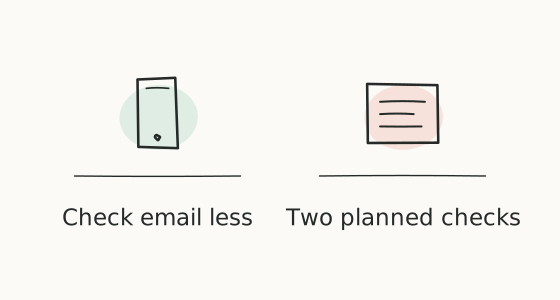
Do we need to measure every area of our lives? Of course not. There are places where a clear boundary is useful. Consider these examples:
- I only process email between 11 a.m. and 6 p.m.
- I keep alcohol out of weekday dinners.
- I transfer a set amount to savings after each paycheck.
- I include two types of vegetables in the meals I prepare each day.
The particular boundary depends on your circumstances. The point is that these statements make the action steps precise and obvious. You can tell what you agreed to do.
Using bright lines to change an old habit
The examples above mostly concern building new behaviors. A clear rule can also help when you want to change an existing one.
Nir Eyal describes a related strategy he calls “progressive extremism.” He uses the example of becoming a vegetarian. Someone interested in making that change might begin by saying, “I don't eat red meat.” That creates a clear boundary in one small area.
Over time, they can move the boundary and add other behaviors. Perhaps they decide that they also want to stop eating fish. Each step gives them a rule they can understand at the moment they are ordering a meal.
That is easier to interpret than “I'm trying to eat a little differently.” It also gives you a chance to learn how a particular change fits before adding another.
Making the decision ahead of time
There are two reasons I find these rules useful.
First, a clear boundary gives you a way to describe a choice you have made. “No thanks, I don't do that” can be a more comfortable response than reopening the whole decision whenever someone asks. You have already thought about it.
Second, a specific rule reduces the amount of deliberation required in the moment. Without a clear boundary, you have to decide whether each situation fits your standards. A rule lets you settle some of those questions ahead of time.
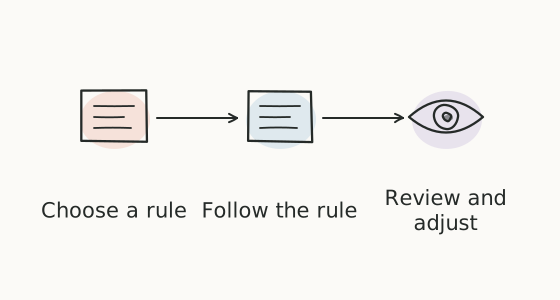
There is still room to revise it. If your email window keeps interfering with work you actually need to do, take time to reconsider the window. You can change the hours or define an exception for something specific. Then you have a rule you can use tomorrow.
I find that more manageable than standing in front of the inbox throughout the day, trying to decide whether this particular check counts as “less frequently.”