How to Optimize Your Daily Decisions
We often buy things because of where they are. Items on store shelves at eye level tend to be purchased more than items on less visible shelves.
In Nudge, Richard Thaler and Cass Sunstein explain a variety of ways that our everyday decisions are shaped by the world around us. The effect that eye-level shelves have on our purchase habits is just one example.
Here's another: the ends of aisles are valuable space for retailers. The products there are easy to see as you move through the store.
Here's why this is important.
Something has to go on the shelf at eye level. Something has to be placed on the rack at the end of the aisle. Something must be the default choice. Something must be the option with the most visibility and prominence.
This is true in nearly every area of our lives. There are default choices in your office and in your car, in your kitchen and in your living room.
My argument is this: if you design the defaults in your life, you can make the things you want to do easier to choose.
Let's talk about how to do that.
Design for default
Although most of us have the freedom to make a wide range of choices at any given moment, we often make decisions based on the environment we find ourselves in.
Imagine sitting at your desk with a glass of water next to you. There are no beers in sight. You could get up, walk to your car, drive to the store, and buy a beer. You probably won't, because you are surrounded by easier alternatives, namely, drinking water. In this case, taking a sip of water is the default decision, the easy decision.
Consider how your default decisions are designed throughout your personal and professional life. For example:
- If you sleep with your phone next to your bed, then checking social media and email as soon as you wake up is likely to be the default decision.
- If you walk into your living room and your couches and chairs all face the television, then watching television is likely to be the default decision.
- If you keep alcohol in your kitchen, then drinking it regularly becomes easier.
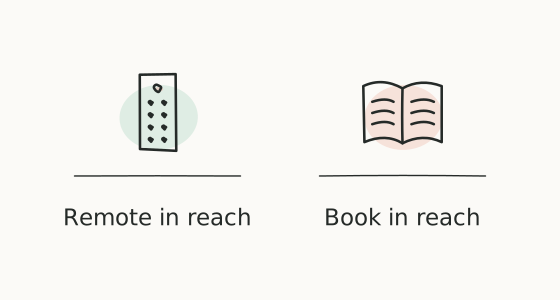
Of course, defaults can be useful as well.
- If you keep a dumbbell next to your desk, then doing a few curls becomes easier to remember.
- If you keep a water bottle with you throughout the day, then drinking water is more likely to be the default decision.
- If you place floss in a visible location, like next to your toothbrush, then flossing is more likely to be the default decision.
Researchers refer to the way choices are arranged as choice architecture. You can change that arrangement. You can design for default.
How to optimize your default decisions
Here are a few strategies for doing that.
Simplicity. It is hard to focus on the signal when you're constantly surrounded by noise. It is more difficult to eat the way you intend when your kitchen is filled with food you were hoping to eat less often. It is more difficult to focus on reading an article when you have ten tabs open in your browser. It is more difficult to accomplish your most important task when you keep switching to something else. When in doubt, eliminate options.
Visual cues. In the supermarket, placing items on shelves at eye level makes them more visible and more likely to be purchased. Outside the supermarket, you can use visual cues to nudge your actions in a useful direction. Move a paper clip from one jar to another each time you complete a repetition. Mark a calendar after a day of practice. Leave the book where you will sit down. Make the action, or the record of doing it, easy to see.
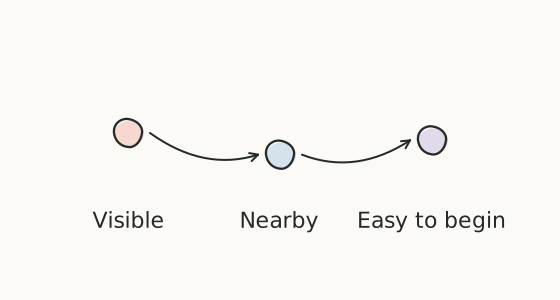
Decide ahead of time. Default settings influence whether people take part in something. You can use a version of this in your own life by making a useful commitment while you have time to think about it.
For example, you could schedule your yoga session for next week while you are feeling motivated today. When the session arrives, it already has a place in the calendar. You can still change your mind. You have removed the need to start the whole decision from scratch.
Designing for default comes down to a simple premise: shift your environment so that the behaviors you want are easier and the behaviors you want less of are harder.
Whose goals does the default serve?
Many companies have goals that directly compete with yours. A food company wants you to buy its bag of chips. A social app wants you to keep scrolling. Your plans for the evening may be different.
For this reason, it is worth questioning the defaults you have accepted. Somebody chose the arrangement, the setting, or the location of the object. You can alter, tweak, and shift your environment until it fits the way you want to use it.
Move the chair. Put the charger in another room. Keep the water on the desk. See what changes, then adjust it again.