Strategies to Help You Bounce Back After Slipping Up
We've all been there.
You commit to working out more, hit the gym for two days, and then struggle to get off the couch after a long day of work. You set a vision for your career and get excited by the possibilities, only to get dragged down in everyday responsibilities and not return to your dream until months later.
I've been there too. There will always be times when following your regular routine is difficult or impossible. Having a way to return helps you keep going.
Here are seven strategies you can use to get back on track.
1. Schedule your habits into your life
Give your habits a specific space in your life. There are two main options for making this happen.
Put it on your calendar. Want to get back to your writing? Nine o'clock on Monday morning. Butt in chair. Hands on keyboard. That's when this is happening.
Want to return to exercise? Give yourself a time and place. Six o'clock on Monday, Wednesday, and Friday might work. Choose an arrangement that fits the week you actually have.
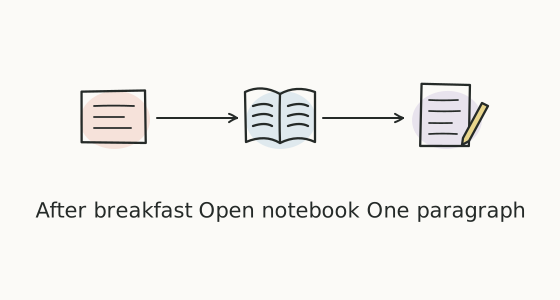
You can also tie the habit to a current behavior. Want to floss? Every day after brushing your teeth. Same order, same way, every time.
Want to make room for gratitude? When you put your keys away at home, name one thing you appreciated that day. The existing action is the reminder.
Getting specific makes it real and gives you a reason and a reminder to get back on track whenever you slip up. When and where, exactly, are you going to do this? You might forget once, but what will remind you the next time?
2. Keep a small version available
If you miss one workout, you don't suddenly lose the progress you have made. The difficulty grows when you never find a way back into the routine.
Keep a smaller version available for the days when time shrinks.
Don't have enough time for a full workout? Do a few movements you know.
Don't have enough time to write an article? Write a paragraph.
Don't have enough time for yoga? Take a few moments to breathe and stretch.
Don't have enough time for the vacation you wanted? A free afternoon in the neighboring town may still give you a break.
Individually, these actions seem small. They can help you stay familiar with the activity through a busy period. Some days will still call for rest or attention elsewhere. Choose the version that makes sense for the day.
3. Have someone who expects to see you
When teammates and coaches expect somebody at practice, showing up becomes a concrete commitment. There is a time, a place, and a person who will notice whether you arrive.
You can create some of that around your own habits. Talk to people at the gym. Arrange a walk with a friend. Meet someone to work on your separate projects at the same table.
Simply knowing that a familiar face expects to see you can be enough to get you to show up.
4. Focus on what you can work with
We can spend a lot of time focusing on what is unavailable to us.
“I don't have enough money. I don't have enough time. I don't have the right contacts. I don't have enough experience. I need to learn more. I'm not sure what to do. I feel uncomfortable and stupid.”
Some of those constraints are real. People begin with very different resources.
It helps to ask, “What can I work with here?”
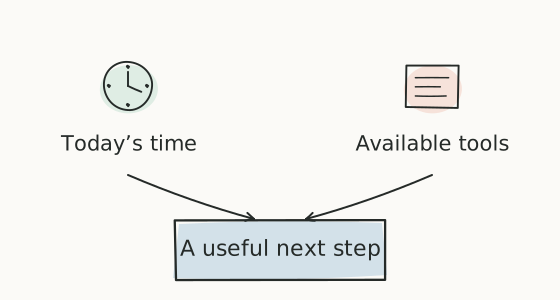
You might have twenty minutes. You might have an unfinished draft you can reopen or a person you can ask a specific question. Look at what is available and choose an action that fits.
You might dislike where you have to start. Your progress might be slow and unglamorous. A manageable action gives you a way to learn more about the next step.
5. Let a useful version count
It's so easy to get hung up on doing things the optimal way and end up preventing yourself from doing them at all.
Here's an example:
“I want to change the way I eat, but I go to Chipotle every Friday with my friends and I like sour cream and cheese on my burrito. Plus, I have a book club meeting every Tuesday and we always have ice cream. I don't want to be the only one sitting out. Maybe I should try something else?”
Does enjoying those meals prevent you from cooking something you want to eat on Monday? No. You can keep those meals with friends and work on another part of the week.
The same problem comes up in exercise, writing, and creative work. Start slowly, live your life, and improve the routine as you learn what fits.
If you are still learning the basics, give them your attention. Do the manageable workout. Cook a few meals. Finish the piece you have started. Practice gives you better information about what to improve.
6. Arrange your environment to help
Motivation is a fickle beast. Some days you feel inspired. Some days you don't. The things around you can offer a more consistent reminder.
Most of us acknowledge that the people who surround us influence our behaviors, but the items that surround us have an impact as well. The signs we see, the things on your desk at work, the pictures hanging on your wall at home. These are all pieces of our environment that can prompt us to take different actions.
Take flossing. If the floss stays in a drawer, you have to remember to get it out. Keeping it next to the toothbrush puts the visual cue in front of you at the moment you could use it. It sounds like a silly thing to focus on. It removes a small obstacle every evening.
Look for a similar change around the habit you want to resume. Put the materials together. Leave the notebook where you sit. Make the next action easy to reach.
7. Care
Make sure that the habits you are trying to stick to are actually important to you.
Forgetting a habit can have many causes. Sometimes it is worth asking how important it is to you. It's remarkable how much time people spend chasing things that they don't really care about. Then, when they don't achieve them, they beat themselves up and feel like a failure for missing something that wasn't important to them all along.
Ask what the habit would help you do. What part of your life would it support? Do you want to make room for that practice?
You only have so much energy to put toward the next twenty-four hours. Choose a habit that matters to you. Use what the previous attempt taught you and give the return a time and place.