Why Trying to Be Perfect Won't Help You Achieve Your Goals (And What Will)
We all have goals that are important to us. How much of getting better comes from the work we do along the way?
There is a classroom story associated with photography professor Jerry Uelsmann that gets at this. David Bayles and Ted Orland tell a version of it using ceramics in Art & Fear. Here is the photography version. It is a teaching anecdote, so I would read it as an illustration of practice.
The danger of aiming for perfection
On the first day of class, Uelsmann divided his film photography students into two groups.
Everyone on the left side of the classroom, he explained, would be in the “quantity” group. They would be graded solely on the amount of work they produced. On the final day of class, he would tally the number of photos submitted by each student. One hundred photos would rate an A, ninety photos a B, eighty photos a C, and so on.
Meanwhile, everyone on the right side of the room would be in the “quality” group. They would be graded only on the excellence of their work. They would only need to produce one photo during the semester, but to get an A, it had to be a nearly perfect image.
In the story, all the best photos came from the quantity group.
During the semester, these students were busy taking photos, experimenting with composition and lighting, testing out various methods in the darkroom, and learning from their mistakes. In the process of creating hundreds of photos, they honed their skills. Meanwhile, the quality group sat around speculating about perfection. In the end, they had little to show for their efforts other than unverified theories and one mediocre photo.
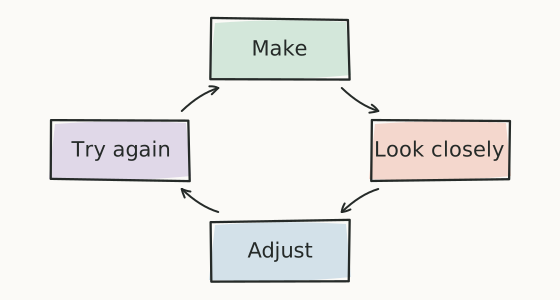
It is easy to get bogged down trying to find the optimal plan for change: the best program to build muscle, the perfect idea for a side business, the right way to begin a piece of work. We can become so focused on figuring out the best approach that we never get around to taking action.
Start with repetitions
Whenever you put in consistent work and learn from your mistakes, you give yourself a chance to improve.
Writing regularly is one example. You can't predict exactly which articles will be useful to people. Producing work, reading it closely, and seeing how people respond gives you something to learn from.
And it works the same way with many other goals.
Art: if you want to be a great photographer, you could go on a quest to take one perfect photo each day. Or you could take one hundred photos, learn from your mistakes, and hone your craft. You still need to look at the pictures. What happened with the light? What did you leave in the frame? The attempts give you material to work with.
Strength: you could analyze every movement and phase of your technique until you're blue in the face. At some point, you need to practice the movement with an appropriate load, learn from the attempt, and return to it.
Writing: you could spend ten years trying to write one perfect book. Or you could finish a book, learn from the process, and bring what you learned to the next one.
Business: you could scheme and think and try to plan out the perfect business idea. Or you could try to get one customer, learn from the experience, and experiment with the next version.
You develop skills by doing a volume of work and paying attention to it. When you think about your goals, consider the repetitions that lead to that place. There is a lot of work before the photograph, book, or product you are happy to show someone.
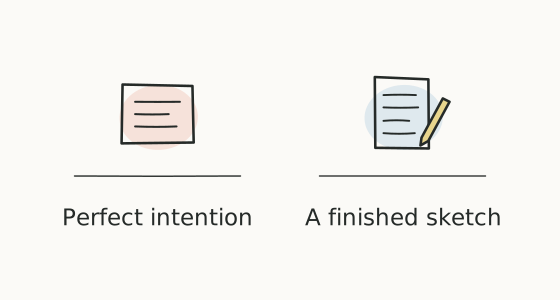
When you look at goals this way, it becomes easier to see why a routine matters. It gives you a way to keep making attempts and learning from them.
For a writing session, that could mean finishing a draft well enough to read it from beginning to end. Then you can see where the thought gets lost, where a story needs more room, or where a sentence sounds like something you would actually say.