How to Stick With Good Habits Even When Your Willpower Is Gone
The more I learn, the more I believe that the choice architecture of your environment plays a major role in building better habits.
Let me drop some science into this article and show you what I mean.
The impact of choice architecture
Anne Thorndike, a primary care physician at Massachusetts General Hospital in Boston, had an idea. She believed she could improve the eating habits of hospital staff and visitors by changing the cafeteria itself.
Thorndike and her colleagues designed a six-month study to alter the way choices were presented. The intervention began with traffic-light labels and then added changes to the placement of items.
Originally, the refrigerators located next to the cash registers were filled with soda. The researchers added water as an option in each one. They also placed baskets of bottled water next to the food stations throughout the room. Soda was still in the primary refrigerators, and water was now available at all drink locations.
During the three-month placement phase, sales of red-labeled beverages fell by 11.4 percent and sales of bottled water increased by 25.8 percent. The traffic-light labels were already in place, so the placement changes added to that earlier intervention. People were encountering water in more places as they went through lunch.
Where a product sits can influence whether we choose it. If I walk into the kitchen and see a plate of cookies on the counter, I might pick up a few and start eating, even if I hadn't been thinking about them beforehand. If the communal table at the office is always filled with doughnuts and bagels, it's going to be hard to pass them every time.
Your habits change depending on the room you are in and the cues in front of you.
Despite our unique personalities, certain behaviors tend to arise again and again under certain environmental conditions. In church, people tend to talk in whispers. On a dark street, people act wary and guarded. We respond to the world around us.
Make the cues more obvious
We are more likely to notice cues that stand out. Unfortunately, the environments where we live and work often make it easy to forget certain actions because there is no obvious cue to begin them.
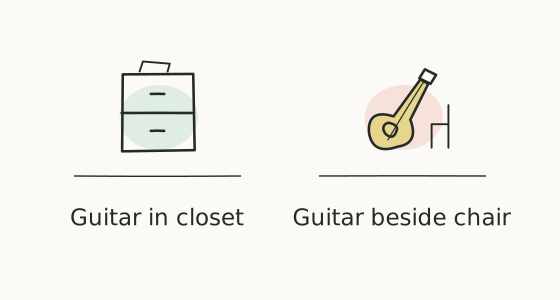
It's easy to skip practicing guitar when it's tucked away in the closet. It's easy to forget to read a book when the bookshelf is in the corner of the guest room. When the cues that spark a habit are subtle or hidden, they are easy to ignore.
Here are a few ways you can redesign your environment and make the cues for your preferred habits more obvious:
- If you want to practice guitar more frequently, place your guitar stand in the living room.
- If you want to remember to send more thank-you notes, keep a stack of stationery on your desk.
- If you want to drink more water, fill up a few water bottles each morning and place them in common locations around the house.
- If you want to read before bed, leave the book where you will sit down.
If you want to make a habit a big part of your life, make the cue a visible part of your environment. Persistent behaviors often have multiple cues.
Consider how many different ways a smoker could be prompted to pull out a cigarette: driving in the car, seeing a friend smoke, feeling stressed at work, and so on.
You can use the same observation to support a habit you want to develop. By placing useful cues throughout your surroundings, you increase the odds that you'll think about the habit during the day.
Make the choice easy to see and act on. The guitar needs to be somewhere you can sit and play. The stationery needs to be near a place you can write. Seeing the object should give you a straightforward way into the activity.
We rarely stop to consider how much of the world around us was arranged by someone else. You can alter the spaces where you live and work to increase your exposure to useful cues. Start with the habit you keep forgetting and the place where it could happen. Put the cue there and see whether you use it.