Three Simple Steps for Sticking With a Habit
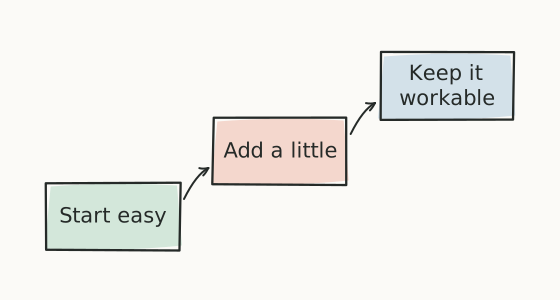
Here is a simple strategy for building habits, governed by three rules.
First I'll tell you the rules. Then I'll explain what they look like in practice, with a few examples you can adapt to your own life.
Three rules for sticking to good habits
- Start with a version of the habit that is incredibly easy for you. It should be easy enough that getting started requires very little effort.
- Increase your habit in an incredibly small way, as the current amount becomes comfortable.
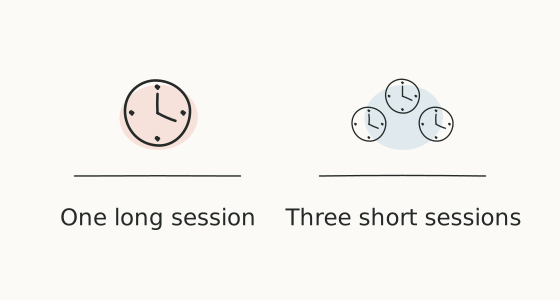
- Even after increasing your habit, keep the repetitions manageable. The total habit can be broken down into easier pieces if needed.
Now, let's talk about what this looks like in real life.
The pushup habit
Pushups make this easy to picture. Take someone for whom ten pushups is a comfortable amount. Here is how they could use the three rules to slowly add more to their routine.
- The first session, they do ten pushups. (Rule 1.)
- The next session, they do eleven. This is a very tiny improvement. (Rule 2.)
- They continue adding one repetition when the current amount feels easy. (Rule 3.)
Once they get to higher numbers, they can break them up into smaller, easier sets. For example, to do fifty pushups, they might do three sets: twenty, twenty, ten. The next increase could be twenty, twenty, eleven.
There are a few things happening here.
First, starting with a habit that is easy in the beginning builds the capacity to do work. There is time to learn how the movement feels and how much recovery it requires.
Second, increasing by a tiny amount gives the person a chance to adapt as the habit grows. This requires some judgment. A daily increase on a spreadsheet can look neat, while an actual person needs rest or a few more sessions at the same amount.
Third, breaking the habit down into easier sets reduces the mental burden needed to accomplish it. Twenty repetitions may feel approachable even when the thought of fifty makes someone put the whole thing off. These easy sets can be fun to do and require very little motivation to finish.
The person is also developing the skill of being consistent, and that is useful in nearly every area of life.
How can you use this in real life?
Here are some other ways you can use this strategy to build new habits. The starting amount and the pace of the increase should fit you.
Meditation. Wish you would meditate consistently and be more mindful? Start with sixty seconds. The next time, try seventy seconds. Continue until you get to an amount of time that satisfies you or is too long to do at once. For example, ten minutes of meditation might feel like a lot. At this point, you could break your sessions into easier blocks: five minutes in the morning and five minutes in the evening.
Walking. You can use a pedometer or an app on your phone to see how much you currently walk. Suppose a thousand steps is a comfortable starting point. Add a hundred steps. An additional hundred steps could be walking down to your mailbox and back, depending on where you live. As the amount grows, you can break your walking time into shorter outings that fit around the rest of the day.
Reading. Wish you were reading more books? On day one, read for one minute. On day two, read for two minutes. Continue until you're reading for a period of time that either satisfies you or is too long to do at once. For example, maybe reading for more than twenty minutes at a time is a stretch for you. If you want to read for thirty minutes, you can break it down into smaller ten-minute blocks.
Flossing. BJ Fogg's example is to start by flossing just one tooth. It gives you a very small action to begin with. Once the floss is in your hands, you can continue with the rest of your routine. The small beginning makes it easier to get there.
Do small habits actually amount to anything?
I know these small gains can seem almost meaningless, especially in the beginning. The arithmetic helps show what they can add up to.
If you followed a simple daily progression for one month, here's what would happen:
- If you started with ten pushups and added one per day, you would do 735 pushups in thirty days. The last day would contain thirty-nine repetitions.
- If you started with one minute of reading and added one minute per day, you would read for 465 minutes in thirty days. That's seven hours and forty-five minutes.
- If you started by walking a thousand steps and added a hundred per day, you would walk 73,500 steps in thirty days. The distance would depend on your stride.
An actual month will have interruptions and adjustments. You may hold the same amount for a while or divide it into smaller sessions. The first version only needs to be something you can comfortably repeat.