The Reasonable and Totally Unsexy Secret to Success
There is a common phenomenon in the world of personal finance called “lifestyle creep.” It describes our tendency to buy bigger, better, and nicer things as our income rises.
For example, say that you receive a promotion at work and suddenly you have ten thousand dollars more of income each year. You might upgrade to a bigger TV or stay at better hotels or buy designer clothes. Your normal lifestyle creeps up slowly and goods that were once seen as a luxury gradually become a necessity. What was once out of reach becomes your new normal.
Changing human behavior is often considered to be one of the hardest things to do in business and in life. Lifestyle creep gives us a familiar example of how it happens over time.
What if we adapted this concept to the rest of our lives? We could begin by paying attention to the ordinary level of activity we already sustain, then changing it a little.
Changing your normal
Let's list some typical financial goals.
- I want to own designer jeans.
- I want to have a bigger house.
- I want to drive a faster car.
Here's the interesting thing: when our purchasing power goes up, our purchases tend to go up too. The new level of spending becomes familiar. That's lifestyle creep.
What if similar changes could happen in other areas of life?
Consider these goals:
- I want to add ten pounds of muscle.
- I want to find a partner and get married.
- I want to earn six figures per year.
- I want to get a higher score on my test.
- I want to own a successful business.
Each of these involves things we can influence and things we can't. Still, improving the routines around them gives us something useful to work on. We can make time to train, meet people, practice a skill, or understand the material we are studying.
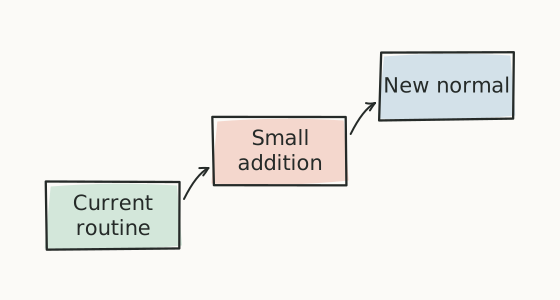
This idea of slightly adjusting your habits until behaviors that once felt out of reach become your new normal is a concept I like to call “habit creep.”
How to practice habit creep
If you buy more things than your bank account can sustain, you end up with debt. Similarly, adopting a bunch of new behaviors you can't sustain gives you a routine that soon becomes difficult to keep up with.
The key is to avoid the trap of trying to grow too fast.
Lifestyle creep happens so slowly that it is almost imperceptible. Habit creep can work the same way. Your goal is to nudge your behaviors along in very small ways.
There are two useful ways to approach this:
- Increase what you do by a little bit. (Most people take this to the extreme.)
- Change your environment to remove small distractions and barriers. (Most people never think about this.)
Here are some thoughts on each one.
Increasing what you do. You have a normal way of living. For example, your usual day includes a certain amount of walking. Let's say that you walk eight thousand steps. The habit creep approach would be to add a very small amount to that familiar behavior. Say, eight thousand one hundred steps. You could take a slightly longer route somewhere you already go.
You can apply this logic to nearly any area of life. You have a normal number of sales calls you make at work each day, a normal number of thank-you notes you write each year, a normal number of books you read each month. You can use the idea of habit creep to improve those areas by making a small change to the way you live your normal day.
Changing your environment. There are all sorts of things we do each day that are a response to the environment we live in. We eat cookies because they are on the counter. We pick up our phones because someone sends us a text. We turn on the TV because it's the first thing we look at when we sit on the couch.
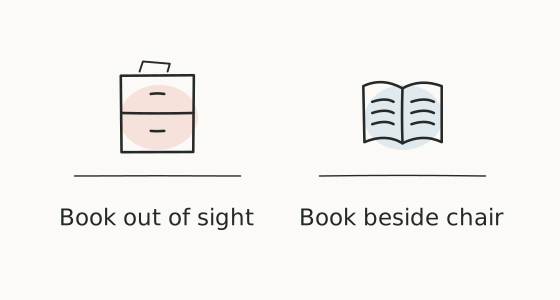
Small changes to that environment can change what we notice and what is easy to do. Put the cookies in the pantry. Leave the phone in another room while you work. Place the TV inside a cabinet. You have changed the situation in which the familiar action happens.
An ordinary day
We spend a lot of time thinking about our best day: getting the best score on a test, running our fastest race, making the most sales in the department.
The ordinary day is worth looking at closely. How much time do you usually spend with the book? What happens when you sit down to work? Is the phone right there? Is the thing you need somewhere you can reach it?
A small adjustment can become familiar before you add anything else. If leaving the phone in another room makes the afternoon easier, you can keep doing that.