How Willpower Works: How to Avoid Bad Decisions
Why do we make unhealthy and unproductive choices, even when we know we should do better?
If you ask most people, they will say that poor choices are a result of a “lack of willpower.”
There is more to look at. The number of decisions in a day, the conditions in which we make them, and how tired or distracted we feel can all matter. A famous study of parole decisions brought this question into a setting where the consequences were unusually serious.
What the parole study found
In a study published in the Proceedings of the National Academy of Sciences, researchers examined 1,112 judicial rulings collected over a ten-month period from Israeli parole boards.
The decisions concerned people seeking parole or changes to their parole or incarceration terms. The researchers noticed a striking pattern across the day's decision sessions.
At the beginning of a session, the proportion of favorable rulings was about 65 percent. As the session went on, that proportion fell toward zero. After a break, it rose again. The pattern made for a dramatic graph and an easy story to remember: a tired decision-maker becoming more likely to leave things as they were.
The explanation is less settled than the graph makes it look.
The study was observational. It did not directly measure depleted willpower, and it could not separate the effects of eating from the effects of resting. A published critique also argued that the order of cases was not random. Prisoner groupings and legal representation could affect both when a case was heard and how likely it was to succeed.
The original researchers defended their interpretation in a reply. The disagreement matters. We have a reported pattern and competing explanations for it. We cannot conclude from this study that hunger caused a particular denial, or that the facts of a case were irrelevant.
What happens after a day of decisions?
One familiar model compares willpower to a muscle. Every time you make a difficult decision, it is like doing another rep in the gym. Eventually you become tired and more inclined to take the easy option.
That model is debated. I would treat it as a way to think about an experience many people recognize, rather than a settled account of a resource being used up.
If you have a particularly decision-heavy day at work, you might come home feeling drained. You want to go to the gym, but sitting on the couch is immediately available. The same thing can happen when you plan to work on a side project at night or cook dinner after a difficult day.
Whatever mixture of fatigue, stress, hunger, and motivation is involved, there are a few ways to make the day easier to navigate.
1. Plan recurring decisions the night before
There will always be decisions that pop up each day that you can't plan for. That's fine. It's just part of life.
Often, the decisions that drain us are the ones that we make over and over and over again. Some of those could be automated or planned in advance.
What am I going to wear to work? What should I eat for breakfast? Should I go to the dry cleaner before or after work? And so on.
Many of those examples can be decided in a few minutes the night before, which means you won't be working through the same choices the next day. Taking time to plan out, simplify, and design the repeated daily decisions can give you more mental space to make the important choices each day.
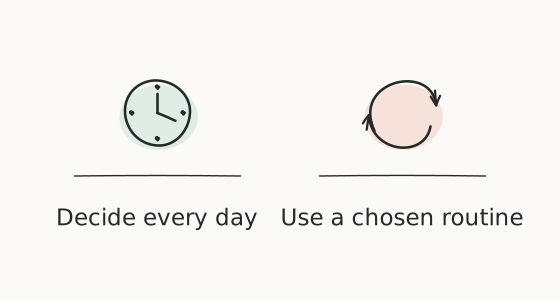
2. Give the important work your best attention
What's the most important thing for you right now?
Is it getting in shape? Is it building your business? Is it writing that book you have inside of you? Is it learning to make room for rest?
Whatever it is for you, put your best energy toward it. If your mornings are when you feel most able to concentrate, protect some of that time. If you work better later, use what you know about your own day.
The practical question is when the work has the best chance of getting your attention. A demanding task left until you are exhausted has a difficult place in the schedule.
3. Give commitments a place in the week
I think advice like “you just need to decide to do it” gets dished around too much.
Of course you need to decide to do the things that are important to you. You also need to schedule them into your life.
We all have things that we say are important to us. “I really want to build my business.” “I really want to get stronger.” “I really want to get started on this project.”
Unfortunately, most of us simply hope that we'll have the willpower and motivation to make the right decisions each day.
For example, a schedule for writing could be Monday and Thursday. A schedule for weightlifting could be Monday, Wednesday, and Friday. On any given Monday, you don't have to decide whether you're going to write. It's already on the schedule. The gym is where you have planned to be on Mondays at 6 p.m. You can adjust the plan if circumstances change, but you have a plan to adjust.
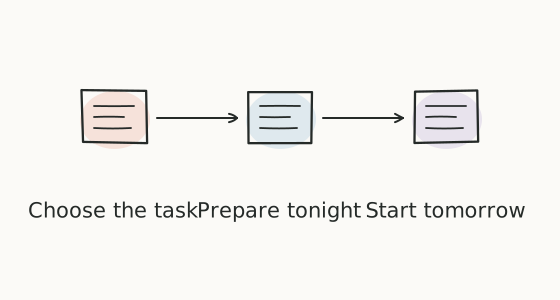
You can also leave the next session ready to begin. Put out the clothes. Leave the document open. Write down the question you want to work on. That saves you from having to reconstruct the whole task when you return.
4. Take a break when you need one
It is not always possible to put important decisions at your favorite time of day. Sometimes they arrive after hours of work.
If you are hungry, eat. If you have been sitting with a problem for a long time, take a break when you can. The parole study cannot tell us that a meal refills a willpower tank. You can still pay attention to whether you are in a reasonable condition to make the decision in front of you.
For a decision that can wait, it may help to write down what needs deciding and come back when you are rested. For one that cannot, a second pair of eyes or a clear set of criteria can help you work through it.
5. Simplify
Whether you are trying to reach a high level of performance or just want a more manageable day, a common frustration is the feeling that you need to use willpower on an hourly basis.
Find ways to simplify your life. If something isn't important to you, consider eliminating it. Making decisions about unimportant things can take time and attention from the things that matter. A familiar breakfast, a recurring appointment, or a short list of priorities can remove some of that daily negotiation.
Look at the decisions you made more than once today. Some of them need your attention each time. Others may be ready for a default you can use tomorrow.