The Paradox of Behavior Change
The natural tendency of many living systems is to maintain stability. In biology we refer to this regulation as homeostasis.
For example, consider your blood pressure. When it dips too low, changes in heart rate and the contraction of blood vessels can help bring it back up. Your kidneys also help regulate blood pressure by controlling how much fluid the body retains. These mechanisms work together, responding as conditions change.
The human body employs many feedback loops to keep your blood pressure, body temperature, glucose levels, calcium levels, and other processes within workable ranges.
In his book, Mastery, martial arts teacher George Leonard points out that our daily lives also develop their own levels of homeostasis. We fall into patterns for how often we do (or don't) exercise, how often we do (or don't) clean the dishes, how often we do (or don't) call our parents, and everything else in between.
Over time, each of us settles into our own version of equilibrium.
Like your body, there are many forces and feedback loops that moderate the particular equilibrium of your habits. Your daily routines are influenced by your environment, your responsibilities, your tracking methods, and many other forces. As time goes on, this equilibrium becomes so normal that it becomes invisible. All of these forces are interacting each day, but we rarely notice how they shape our behaviors.
That is, until we try to make a change.
The myth of radical change
The myth of radical change and overnight success is pervasive in our culture. We hear things like, “If you want massive results, then you have to take massive action.” On the surface, these phrases sound inspiring. What we can overlook is how many stabilizing forces are already at work in our lives.
If you step too far outside the bounds of your normal routine, a lot of those forces can pull you back toward the familiar. You take massive action, then quickly run into a massive roadblock.
Nearly anyone who has tried to make a big change in their life has experienced some form of this. You finally work up the motivation to change what you eat, only to find your co-workers making it harder to follow through. You commit to going for a run each night and within a week you're asked to stay late at work. You start a new meditation habit and your kids keep barging into the room.

The forces in our lives that have established our current equilibrium can pull us back whether we are trying to change for better or worse. In the words of George Leonard, “Resistance is proportionate to the size and speed of the change, not to whether the change is a favorable or unfavorable one.”
The pursuit of rapid change can dial up a wide range of counteracting forces. You might be able to overcome them for a little while, but pretty soon your energy fades and the backsliding begins.
The optimal rate of growth
Change is certainly possible. The pace matters, though. When an athlete trains too hard without enough recovery, she risks getting injured. When a company changes course too quickly, the culture can break down and employees can get burnt out.
Systems thinker Peter Senge describes this in terms of an optimal rate of growth. In his account, the fastest possible growth can be faster than a system can sustain. An organization may need time to train people, develop its processes, and absorb what has already changed.
When you accumulate small wins, you can nudge your normal routine forward. It is like building muscle. If the challenge is always well within your ability, there may be little reason for your body to adapt. If the weight is too heavy, you can get injured. With an appropriate increase and time to recover, your muscles can adapt to the new stimulus.
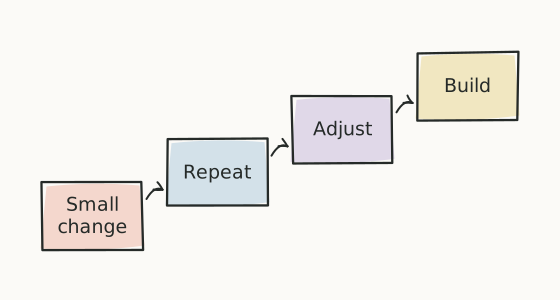
The amount of change you can manage will vary. Some periods give you more time and support than others. A smaller change also gives you a chance to see what is getting in the way before you add more.
The paradox of behavior change
For change to last, it helps to work with the forces already operating in your life.
Much of your daily life has a typical rhythm. If you reach too far beyond that rhythm all at once, you can find yourself being pulled back to the baseline. Small wins give you a way to develop a new normal.
This is the paradox of behavior change. You may want a very different life, and the practical work begins with an ordinary day. A run that fits around work. A few minutes of meditation when someone else can watch the kids. A change to the food you keep at home. Each gives you a chance to find out what you can repeat.