Use This Simple Daily Habit to Add More Gratitude to Your Life
There is a simple gratitude habit that fits into a part of the day most of us already have: sitting down to eat dinner.
First, let me set the stage.
The minor tragedy
Imagine ordering takeout from your favorite Indian restaurant for dinner. The family has a tight timeline that night. You have about an hour together before everyone has to run off in separate directions.
You pick up the food and drive home. When you open the bag, you realize that the restaurant has forgotten one of the main dishes.
In the grand scheme of things, this is a small problem. At the moment, it is a hassle. Either someone drives back to get the food while the others pack their bags, or everyone makes do with half the dinner you ordered.
One person volunteers to go back. Forty minutes later, the food is finally on the table. There are twenty minutes to eat before everyone has to get back in the car.
It seems frivolous in retrospect, and this is exactly the type of little hassle that can ruin the mood and pull everyone into a negative spiral, especially when you are in a rush. The evening has become frustrated, rushed, and stressed.
Now imagine a familiar question at the beginning of that meal: What is one thing you're grateful for that happened today?
Someone mentions a short shopping trip earlier in the day. It gave you time together that you didn't get to spend later in the evening. Someone else remembers their own small moment.
The missing food can still be annoying. There is also something else to talk about while you eat.
The daily gratitude habit
The habit is super simple. Here it is:
When you sit down to eat dinner, say one thing you are grateful for that happened today.
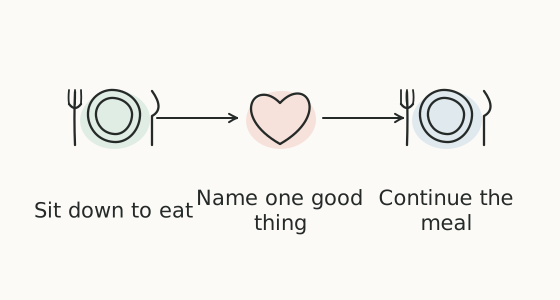
It takes a few seconds. It can be something small, something you would otherwise forget by tomorrow. A good conversation. Time with someone you care about. Something nice someone said. A few quiet minutes outside.
For me, time walking with Cora or time with Becca belongs in this category. These are ordinary parts of life that I want to pay attention to while they are happening.
Why this fits into a day
There are a few things I like about this practice.
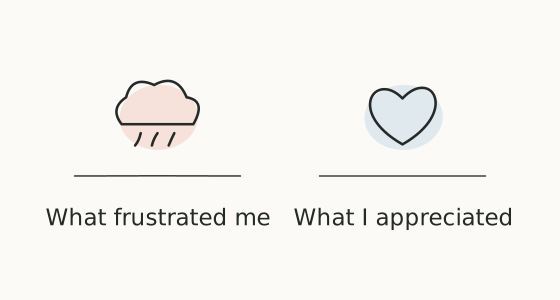
It gives you a regular moment to notice what you appreciate. Everyone has bad days and frustrating moments, myself included. Dinner offers a familiar place to pause long enough to remember something else from the day. Sometimes the answer will come easily. Sometimes it may take a little thought.
The individual moment can be small. Repeating it gives you more chances to notice things you might otherwise pass over. You start looking back at the actual day: the person who made you laugh, the food someone prepared, the hour you finally had to work on something that matters to you.
Many of these moments cost very little. Time spent with friends and family, something kind someone said, a good walk. It can be comforting to notice how often the thing you appreciate was already part of an ordinary day.
The habit is stupidly small. You are saying one thing. There is no page to fill and no elaborate routine to arrange around it. It can fit even when dinner itself has become a rushed affair.
It is also tied to another behavior. This is the idea behind habit stacking: attach a new action to something that already happens. Sitting down with your food becomes the reminder. You can use another meal if that fits your day better.
What gratitude looks like
Gratitude is an interesting concept. It's one of those qualities that everyone accepts you should practice, and we rarely talk about how to do it. It's sort of like saying you should “live in the moment.” It's easy advice to give. You'll hear fewer explanations of what someone actually does during the day.
Here, there is a specific action. You sit down, think back over the last few hours, and name something you appreciate.
On a difficult day, the answer can include the difficulty. “I'm glad you came with me to that appointment.” “I'm grateful we got to talk after such a long afternoon.” You can be honest about the day you had.
Then you eat dinner. In the takeout example, there are still only twenty minutes before everyone needs to leave. At least some of that time can be spent talking about the shopping trip, or whatever else someone remembered.