How the World Around You Shapes Your Thoughts and Actions
In 1952, nearly 58,000 cases of polio were reported in the United States. The country desperately needed a vaccine.
In a small laboratory at the University of Pittsburgh, a young researcher named Jonas Salk was working tirelessly to develop a vaccine. Despite all his effort, Salk was stuck.
Eventually, he decided that he needed a break. Salk left the laboratory and retreated to the quiet hills of central Italy where he stayed at a 13th-century Franciscan monastery known as the Basilica of San Francesco d'Assisi.
The basilica could not have been more different than the lab. The architecture was a beautiful combination of Romanesque and Gothic styles. White-washed brick covered the expansive exterior and dozens of semicircular arches surrounded the plazas between buildings. Inside the church, the walls were covered with stunning fresco paintings from the 14th and 15th centuries and natural light poured in from tall windows.
Salk later described how the change of surroundings helped his thinking:
“The spirituality of the architecture there was so inspiring that I was able to do intuitive thinking far beyond any I had done in the past. Under the influence of that historic place I intuitively designed the research that I felt would result in a vaccine for polio. I returned to my laboratory in Pittsburgh to validate my concepts and found that they were correct.”
Did inspiration just happen to strike Salk while he was at the monastery? Or was he right in thinking that the environment had influenced his thinking?
His recollection can't tell us exactly how much the place contributed. It gives us a useful question to consider: how do our surroundings affect the way we think and act?
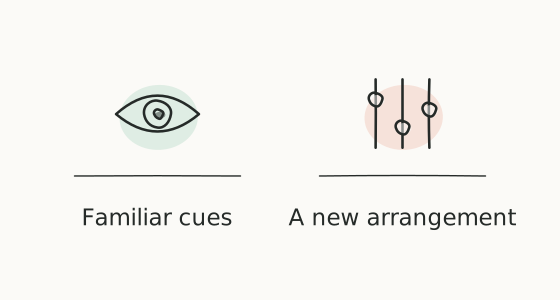
The link between buildings and behavior
Researchers have explored a variety of ways that the buildings we live, work, and play in influence our behavior and our actions. The way we react and respond is often tied to the environment that we find ourselves in.
Natural light, air, noise, the presence of natural elements, and the size of a room can all change the experience of being there. Studies have also examined how features such as ceiling height affect the way people approach particular tasks. Those findings depend on the setting and the task, so a bigger room is no guarantee of a better idea.
What does this connection between design and behavior mean for you and me?
Change the cues around you
Many habits become associated with a trigger or cue. Those cues often come from the environment.
This is important because most of us live in the same home, go to the same office, and eat in the same rooms day after day. And that means you are constantly surrounded by the same environmental triggers and cues.
If your behavior is often shaped by your environment and you keep working, playing, and living in the same environment, then it's no wonder that it can be difficult to build new habits.
If you're struggling to think creatively, then going to a wide open space or moving to a room with more natural light and fresh air might help you solve the problem. If you need to focus, a quieter, more contained space may make it easier to stay with the task.
Simply moving to a new physical space, whether it's a different room or halfway around the world, will change the cues that you encounter and may change your thoughts and behaviors.
Putting this into practice
In the future, I hope that architects and designers will use the connection between design and behavior to build hospitals where patients heal faster, schools where children learn better, and homes where people live happier.
You can also start making changes right now.
Here is a simple way to start:
- To support a habit, reduce the number of steps required to perform the behavior.
- To interrupt a habit, increase the number of steps required to perform the behavior.
Here are some examples.
Want to watch less TV? Unplug it and put it in a closet. If you really want to watch a show, then you can take it out and plug it back in.
Want to drink more water? Fill up a few water bottles and place them around the house so that a drink is always close by.
Want to start a business? Try a coworking space where you are surrounded by other people building businesses. See whether the setting helps you do the work.
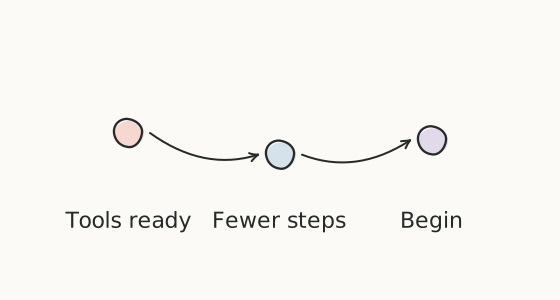
BJ Fogg refers to this approach as “designing for laziness.” In other words, change your environment so that your default or “lazy” decision is a better one.