How to Stay Focused When You Get Bored Working Toward Your Goals
We all have goals and dreams, and it can be difficult to stay focused and stick with them.
People say things like, “I start with good intentions, but I can't seem to maintain my consistency for a long period of time.” Or, “I get started but I can't seem to follow through and stay focused for very long.”
I recognize the pattern. Start one project, work on it for a little bit, lose focus, and try something else. Then lose focus on the new goal and try something else. When everything is said and done, there has been so much starting and stopping that very little has had time to develop.
Maybe you have felt this way, too.
Handling the ordinary days
An experienced coach who had worked with nationally ranked athletes and Olympians was asked what separated the best athletes from everyone else. What did the really successful people do that most people didn't?
He mentioned the factors you might expect: genetics, luck, talent. Then he added something less glamorous: at some point, it comes down to who can handle the boredom of training every day, doing the same lifts over and over and over.
That is a different way of thinking about work ethic. People talk about getting “amped up” to work on their goals. Whether it's business or sports or art, you hear things like, “It all comes down to passion.” Or, “You have to really want it.”
It is easy to get discouraged when you lose focus or motivation because you think successful people have some bottomless reserve of passion. The coach was describing people who also get bored and still find a way to show up.
Working when the work feels difficult
Anyone can work hard when they feel motivated.
Think about a team going to practice the week after a big win. The coach is happy, the teammates are pumped up, and everybody feels like they can beat anyone. In a business, customers are coming in and things are going well. Getting results has a way of propelling you forward.
What about when you're bored? What about when it feels like nobody is paying attention or you're getting very little of the result you wanted?
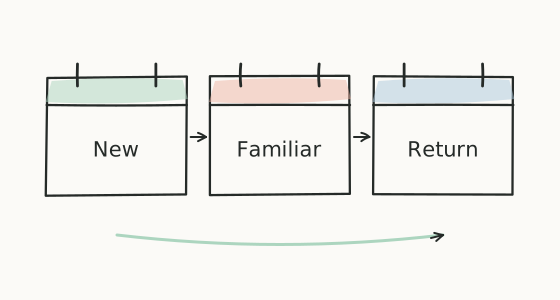
Those days belong to the practice, too. If the work still matters to you, you need a way to engage with it while it feels ordinary. A familiar time, a manageable session, somebody expecting you to arrive. Something that helps you begin while your enthusiasm is elsewhere.
That also leaves room to pay attention. Boredom can be part of repetition. It can also tell you that you need a different challenge or that the project needs to change. Continuing gives you something concrete to examine. You can see which part is difficult and decide what to do with it.
The practice continues after the milestone
All too often, we see success as an event that can be achieved and completed.
Here are some common examples:
- “If I just reach this weight, then I'll be in shape.”
- “If we could get our business featured in the New York Times, then we'd be set.”
- “If I could just get my work featured in a bigger gallery, then I'd have the credibility I need.”
Those are a few of the ways we turn success into a single event. We picture the moment arriving and imagine the uncertainty ending with it.
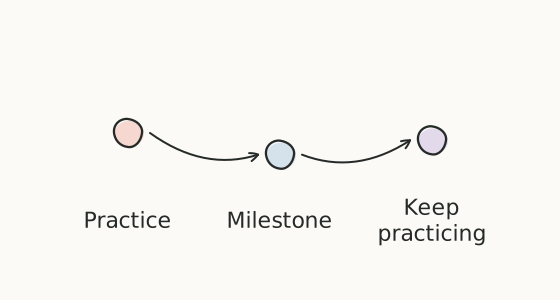
The people who continue developing their work have a practice that carries on around those events. They write, make things, train, revise, and return. A milestone may bring opportunities and a wonderful feeling of progress. There is still another day of work afterward.
If you want to be a writer, having a bestselling book would be wonderful. You also need a way to spend time writing: beginning a piece, finding out what you mean, working through the part that refuses to come together.
If you want people to know about your business, being featured in a magazine may help. You still have to keep understanding the people you serve, explain the work, and deliver something worth returning to.
If you want to feel stronger and more capable, the ongoing practice of moving, training, eating, and resting deserves attention. You are going to live with those actions much longer than any single milestone.
Becoming significantly better at something involves a lot of time doing it. Some of that time will be exciting. Some of it will feel familiar enough to be boring. Choose a practice you care about enough to keep returning to, and make room for the ordinary sessions as well.