The Habits Scorecard: Discover Which Habits You Want to Change
If you ever find yourself riding a train in Tokyo, you may notice that the operators have a peculiar habit.
As each operator runs the train, they proceed through a ritual of pointing at different objects and calling out what they see. When the train approaches a signal, the operator will point at it and say, “Signal is green.” As the train pulls into and out of each station, the operator will point at the speedometer and call out the exact speed. When it's time to leave, the operator will point at the timetable and state the time.
Out on the platform, other employees are performing similar actions. Before each train departs, staff members point along the edge of the platform and check that it is clear. Details are identified, pointed at, and named aloud.
This process, known as Pointing-and-Calling, is a safety system designed to reduce mistakes. Research by Japan's Railway Technical Research Institute has tested how these deliberate actions help people notice and remember what they are checking. The effect varies with the task.
Pointing-and-Calling your habits
The process raises awareness of a familiar action. Because operators use their eyes, hands, mouth, and ears, they have several opportunities to notice a problem.
You can picture a smaller version while packing for a trip. Someone is standing at the door, calling out the essential items: “I've got my keys. I've got my wallet. I've got my glasses. I've got my husband.”
The more automatic a behavior becomes, the less likely we are to consciously think about it. When we've done something a thousand times before, we begin to overlook things. We assume that the next time will be just like the last. We're so used to doing what we've always done that we can forget to ask whether the routine still makes sense.
One of our greatest challenges in changing habits is maintaining awareness of what we are actually doing. This helps explain why the consequences of an unwanted habit can sneak up on us. A personal version of Pointing-and-Calling gives us a way to notice.
The Habits Scorecard
To create your own Habits Scorecard, start by making a list of your daily habits. Here's a sample of where your list might begin:
- Wake up.
- Turn off the alarm.
- Check my phone.
- Go to the bathroom.
- Take a shower.
- Brush my teeth.
- Floss my teeth.
- Put on deodorant.
- Hang up the towel to dry.
- Get dressed.
- Make a cup of tea.
And so on. Keep going through the ordinary sequence. Include the actions that seem too small to matter. Checking the phone before you've even got out of bed is easy to leave off a description of your morning, even if it happens every day.
Once you have a list, look at each behavior and ask what it is doing for you. Does it help with something you care about? Does it get in the way? Is it fairly neutral?
You can use a “+” for a helpful habit, a “-” for something you would like to change, and an “=” for a neutral action.
For example, waking up and turning off the alarm might receive an “=”. Checking your phone might receive a “-” if it regularly pulls you into work messages before you are ready. Brushing your teeth might receive a “+”. The cup of tea might be something you enjoy and want to keep.
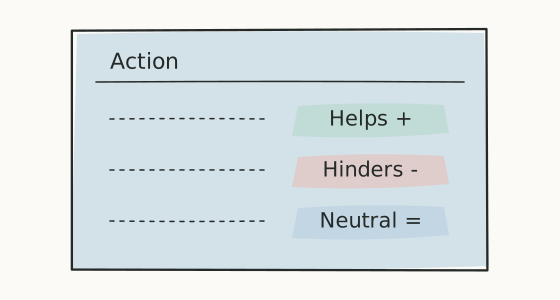
The marks depend on your situation and your goals. Someone waiting for an important message may have a good reason to look at their phone early. Someone else may find that the same action regularly turns five quiet minutes into half an hour of scrolling. You are looking at what happens in your own day.
How do I know whether a habit is helping?
Scoring your habits can be more complicated than it first appears. A habit can be useful in the moment and create a problem later. That immediate usefulness helps explain why you repeat it.
Opening a social app may provide a welcome break when you are tired. It may also make it difficult to return to the thing you were doing. Both parts belong in your understanding of the habit.
Here is a question I like to use: “Does this behavior help me become the type of person I wish to be?” You can also ask something more immediate: “How does this leave me feeling, and what does it make easier or harder to do next?”
The score is only a rough note to yourself. Some actions will deserve a sentence of explanation. That is fine. You are trying to see the routine clearly enough to decide what you want to do with it.
Where to go from here
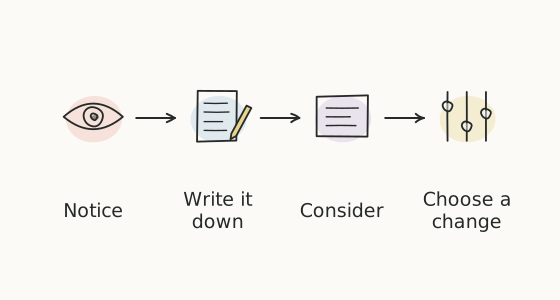
As you create your Habits Scorecard, there is no need to change anything at first. The goal is to simply notice what is actually going on. Observe your thoughts and actions without turning the list into an exercise in self-criticism.
If you spend time online each morning, acknowledge it almost as if you were watching someone else. Oh, how interesting that they would do such a thing. What happened just before they opened the app? How long did they stay? What were they hoping to find?
Write down what you notice. You can decide which part to change once you have a more complete picture of the day.