How to Stick With Good Habits Using the Paper Clip Strategy
In 1993, a bank in Abbotsford, Canada, hired a twenty-three-year-old stockbroker named Trent Dyrsmid.
Abbotsford was a relatively small city near Vancouver, where many of the big business deals were being made. Dyrsmid was a rookie. He made brisk progress with the help of a simple daily habit.
The Paper Clip Strategy
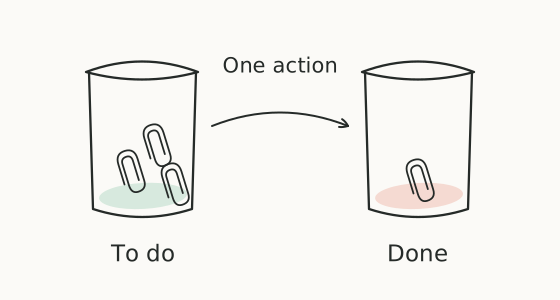
Dyrsmid began each morning with two jars on his desk. One was filled with 120 paper clips. The other was empty. As soon as he settled in each day, he would make a sales call. Immediately after, he would move one paper clip from the full jar to the empty jar and the process would begin again.
“Every morning I would start with 120 paper clips in one jar and I would keep dialing the phone until I had moved them all to the second jar,” he explained in an interview.
Within eighteen months, his book of business reportedly grew to five million dollars in client assets. By age twenty-four, he was making seventy-five thousand dollars a year. Not long after, he landed a six-figure job with another company.
Asked about the details of his habit, Dyrsmid said, “I would start calling at 8 a.m. every day. I never looked at stock quotes or analyst research. I also never read the newspaper for the entire time. If the news was really important, it would find me from other ways.”
He had given one fundamental part of his work a very clear place in the day. The jars showed him whether he had done it.
Compare this with where you and I often find ourselves. We want to be consistent with our workouts and struggle to make it into the gym. We know we want to write more thank-you notes or read more books, and somehow another week goes by. We'd like to achieve our goals and still procrastinate on them.
What makes the paper clips useful? They create a visual cue to begin and a visible record of what you have done.
The power of a visual cue
There are plenty of ways to use the same idea. A writer can shift a hairpin from one container to another whenever they finish a page. Someone practicing an exercise can move a marble after each set.
Making progress is satisfying. Visual measures, like moving paper clips or hairpins or marbles, provide clear evidence of your progress. They add a little bit of immediate satisfaction to an activity whose larger results may take a while to appear.
Here are a few reasons visual cues work well for building new habits.
Visual cues remind you to start a behavior. We often overestimate our ability to remember to perform a new habit. (“I'm going to start doing this. For real this time.”) A few days later, the motivation fades and the busyness of life begins to take over again. This is why a visual stimulus, like a jar full of paper clips, can be so useful. It is much easier to remember a habit when your environment keeps bringing it to your attention.
Visual cues display your progress on a behavior. We know consistency matters, and it can be hard to recall how often we actually did something. The Paper Clip Strategy has a built-in measuring system. One look at your paper clips and you have a measure of your progress for the day.
Visual cues can add to motivation. As the visual evidence of your progress mounts, it can become easier to want to continue. There are already paper clips in the second jar. You can see what you have completed and what remains.
Visual cues can show different stretches of time. The jars provide a daily record, and you start again each morning. A calendar can show the days on which you practiced over the last few weeks or months. Put the two together and you can see both today's work and the longer pattern.
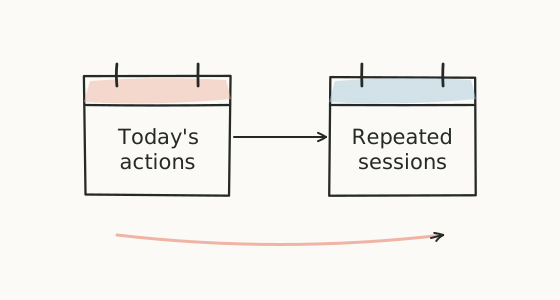
A calendar will have gaps. Keep them visible along with the days you returned. They can help you see whether the amount you chose fits the rest of your life, or whether a particular day of the week keeps being difficult.
Creating your own Paper Clip Strategy
There are all sorts of ways to use paper clips for your own goals.
- Planning several sets of an exercise? Start with one paper clip for each set and move it over when the set is complete.
- Need to send twenty-five sales emails? Start with twenty-five paper clips and toss one to the other side each time you press Send.
- Working through a piece of writing? Choose a small unit of work, perhaps a page reviewed, and move a paper clip when you finish it.
- Want to keep track of a handful of household jobs? Put out a paper clip for each one and move it after the job is done.
The unit needs to mean something you actually completed. It is easy to start counting activity that feels like work: opening a document, rearranging a list, reading another article about the thing you intend to do. Decide what the paper clip stands for before you begin.
You can use two jars you already have and a handful of paper clips. Pick your habit and start moving those bad boys from one side to the other.