Do the Painful Things First
One lesson from designing a good customer experience is useful well beyond a business.
Behavioral researchers have studied how the order of an experience affects the way we remember it. We tend to prefer experiences that improve over time. That means it can help for the annoying parts of a purchase to happen early in the experience. Furthermore, we don't enjoy it when painful experiences are drawn out or repeated.
Here are some examples.
- If you're at the doctor's office, consider the difference between spending twenty minutes in the waiting room and spending ten minutes in the waiting room followed by ten minutes in the exam room. Being moved and then made to wait again can feel like a fresh disappointment.
- People enjoy all-inclusive vacations because they pay one lump sum at the beginning (the pain) and the rest of the trip is divided into positive experiences, excursions, and parties. The arrangement segments the pleasure and combines the pain.
- If you're a professional service provider (lawyer, insurance agent, freelancer, etc.), it can help to give the bad news to your clients first and finish with the good news. They have time to understand the problem and leave with a better sense of what comes next.
These examples have me thinking.
If you can make a customer experience more delightful, why not make your life experiences more delightful?
How can you take advantage of the way your brain processes painful and annoying experiences, and use that knowledge to make an ordinary day more enjoyable?
To boost happiness, stack the pain
A delightful customer experience combines the painful experiences into a single segment that occurs early in the process and then improves over time. You can try arranging your day in a similar way.
Here is an example.
On a normal day, you might have something annoying or painful to do (like paying the bills). And you also might have something good happen to you (like a friend sending you a thoughtful email).
If you read the email on your lunch break and then pay the bills when you get home from work, you may remember your day as going from a good experience to a bad experience.
However, if you decide to stack the pain early in your day, for example, if you pay your bills in the morning before you go to work and then read the email from your friend on your lunch break, the sequence goes from bad to good. You also have less time with the unfinished task hanging over you.
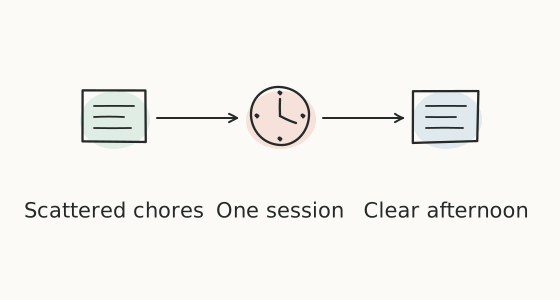
This same principle can be applied in dozens of ways throughout your day.
When you're working on a project, cleaning the house, or doing homework, start with the task that you dislike the most. Once that is out of the way, your experience can improve and you may finish with a more satisfied feeling.
When you're trying to start a new habit, combine the effort of starting into a small segment. For exercise, that might mean finding your clothes, packing the bag, and filling the water bottle together. By reducing the hassle you feel at the beginning, you make it easier to follow through.
When you go to the gym, you might start with an exercise you dislike, after warming up and as long as the order makes sense for the workout. With that exercise out of the way, your experience can improve throughout the session. And when you remember your workouts as enjoyable, it's easier to imagine showing up next time.
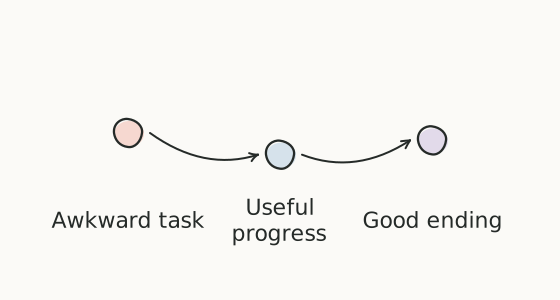
Stacking the pain for the long term
It's easy to worry about making the right choices with your life. Some pursuits have a lot of their difficulty in the beginning: building a business, learning a new skill, or creating art. As you learn, parts of the experience can improve.
By comparison, an activity like gambling can provide big wins and big losses at any time. The pain isn't necessarily in the beginning. Having already endured a difficult period tells you very little about what comes next.
Of course, that can be easy to forget when you're struggling to succeed with other goals. In the beginning, it can be easy to feel like, “Building a business is so hard. Why shouldn't I try something else?”
Understanding how an experience can develop may help you continue to work on a skill even when the day-to-day grind gets frustrating.
- It might be painful now to put in the work required to get in shape or become a better athlete. As your skills improve over time, you may find yourself enjoying things that were difficult at first.
- It might be painful now to create bad art. As you learn your craft and your work gets better, you have more ability to make what you had in mind.
- It might be painful now to work through the uncertain early years of entrepreneurship. Learning to build a stable business can change what the daily experience feels like.
There is a real judgment to make here. Some difficult experiences stay difficult, and some goals need reconsidering. I would look for evidence that the work is helping: a skill developing, a recurring problem becoming easier, a part of the process I am beginning to enjoy.
Choosing to front-load discomfort can also help with the smaller tasks we procrastinate on. Put the annoying errands together, give them a place to finish, and leave something enjoyable afterward.