How to Fall in Love With Boredom and Unlock Your Mental Toughness
Mastery is never an accident. You can win the lottery and become rich overnight, but no one has ever mastered their craft by chance. Whether we are talking about athletes, artists, or academics, the story is the same. Developing a skill takes practice over a long time.
Paul Erdős, the fantastic mathematician, published more than 1,500 papers over his lifetime. Famous composers have spent years doing underappreciated work before earning recognition. And there is the story of Milo of Croton, the Greek wrestler who, according to legend, picked up a young calf every day and kept lifting it as it grew.
Somehow, people who become very good at a craft figure out a way to put in their reps and do the work.
Of course, whenever “experts” share stories about successful people they often leave out a key ingredient of the story. How, exactly, do people learn to live with the boredom? Perhaps more important, how can you do it when you're trying to build a habit that you know you should do, but you don't really want to do?
Let me share two strategies.
How to fall in love with boredom
First, there is very little hope for falling in love with a habit that you truly hate. I don't know anyone who legitimately dislikes an activity and somehow falls in love with doing it. It doesn't add up. It's very difficult to hate something and be in love with it at the same time. (Your ex doesn't count.)
Let's say you dislike working out, but you know it's good for you. If you want to enjoy returning to the gym, then you have a couple of options.
Increase your proficiency at the task
Even tasks that you are good at will feel monotonous some days, so imagine the uphill battle you're fighting if you are constantly trying to do something that you don't feel skilled at.
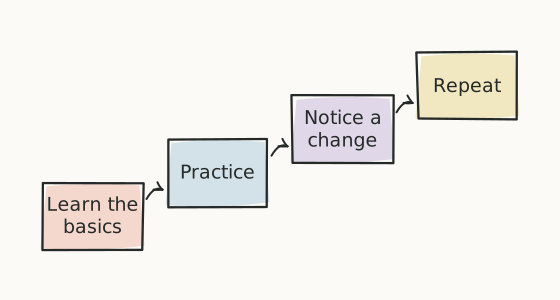
The solution? Learn the basic fundamentals of your task and celebrate the small wins and improvements you make.
With our workout example, let's say you learn how to do a proper deadlift or bench press, with guidance suited to your ability. Practicing these new skills in the gym can be fun, and making tiny improvements each week builds momentum. It's much easier to fall in love with doing something over and over again if you can look forward to making progress.
Find a result you enjoy
Let's be real: there are some things that we want to do that are always going to be a hassle. Running sprints might be an example. Very few people look forward to setting their lungs on fire.
In situations like these, it can help to shift your attention toward a result. Sometimes this is a direct result of the habit you're trying to perform. Other times, it's something you invent.
For example, you can make a game out of keeping a workout schedule even if you don't enjoy every workout. Let's say you have done two planned workouts in a row. Your goal is to enjoy becoming the type of person who returns to the activity. For the moment, you can give your attention to keeping that routine going.
This is the calendar-chain idea applied to exercise. You mark the sessions you complete and give yourself something visible to continue. By shifting your attention, you're giving yourself another reason to return to a familiar task.
The schedule still needs recovery days and room for illness or injury. A streak is useful when it helps you care for the practice. If it starts asking you to ignore what your body needs, adjust it.
The power of patience
Imagine someone changing a weightlifting routine despite making good progress with the old program. Ask why, and after a few explanations the answer is, “Basically, I got bored.”
I think that is an easy place to find ourselves. The program is working, but it is familiar now. Something new starts to seem more promising simply because it is new.
I'm starting to believe that patience and consistency are a difficult combination to beat. Progress is often found by practicing the fundamentals that everyone knows they should be doing, but finds too boring or basic to practice routinely.
It's like making 120 sales calls per day. There's nothing sexy about it. There are still things to practice inside the repetition: how you begin the conversation, what you ask, how well you listen to the answer. If the practice is helping, there may be a good reason to stay with it for a while.