Why Is It So Hard to Stick to Good Habits?
Have you ever set out with the goal of actually sticking to a new behavior, only to find yourself barely doing it one week later?
I know I have.
Why is it so hard to form good habits? Why is it so difficult to make consistent change? How can we have the best intentions to become better and still see so little progress?
And is there anything we can do about it?
What our goals ask of us
Seth Godin has written about how an audacious goal can distract us from the daily changes it would require. I think that's a useful thing to look at.
We all have hopes and dreams. Most of the time, we have at least a general sense of what those goals are: the good health we want to enjoy, the respect we want to receive from our peers, the important work we want to create, the relationships we want with our family and friends, and the love we want to share.
Overall, this is a good thing. It's nice to know what you want, and having goals gives you a sense of direction and purpose. There is also a way that your hopes and dreams can get in your way: your desires can easily lure you into biting off more than you can chew.
You know exactly what I mean.
You get inspired by The Biggest Loser, head to the gym, bust your butt to the point of exhaustion, and take the next three months off to recover. You finally get that urge to write your book, write all day over the weekend, and then head back to your day job on Monday and never come back to it. You're motivated by your friend's stories of traveling to new countries, so you start to plan your own around-the-world trip, only to end up overwhelmed by all the details and stay at home.
Too often, we let our motivations and desires drive us into a frenzy as we try to solve our entire problem at once. The small routine that would fit into the next ordinary week gets very little attention.
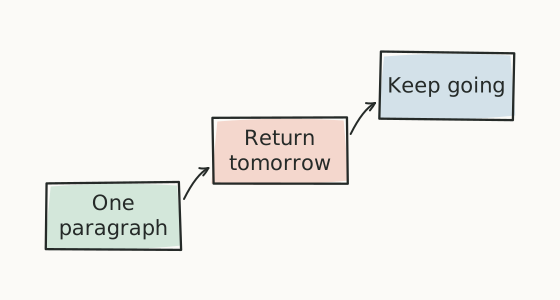
So how do we balance our desire to make life-changing transformations with the need to build small, sustainable habits?
Start small
If you're serious about making a change, start with a behavior you can repeat.
Imagine the typical habits, good or bad: brushing your teeth, putting your seatbelt on, biting your nails.
These actions are small enough that you often do them without thinking. They are tiny actions that become consistent patterns.
Wouldn't it make sense that if we wanted to form new habits, a good place to start would be a tiny change our brain could learn and repeat?
You could begin with a twenty-minute walk, or a shorter one if that fits your day. You could open the draft and work through a paragraph. You could spend ten minutes looking into one part of the trip you want to take.
The action has a place in the day and an ending you can reach. You can do it again tomorrow.
BJ Fogg uses the image of planting the right seed in the right spot. The seed is the small behavior. The spot is where it fits in the sequence of your day. A new action that follows an existing routine has somewhere to take root.
That is something you can experiment with. After lunch, walk. After making coffee, open the notebook. You may have to change the time or make the action smaller. You are learning what fits.
The usual temptation is to dive into the deep end as soon as you get a dose of motivation. Then, when the routine is difficult to sustain, you wish you had more willpower. Start in the shallow water and give yourself time to learn how to swim.
Look at the week you would be living
We spend a lot of time thinking about the transformation. It helps to picture the routine that would support it.
- Publishing a book would be a major event. Writing regularly and making time to contact an agent are things you can put into a week.
- Running a marathon would be a major event. Running three days a week is a routine you can build toward.
- Earning more through freelance work would change your finances. Setting aside a few hours each week gives you time to do the work and find clients.
- Getting stronger takes time. A manageable training schedule gives you something to practice while that happens.
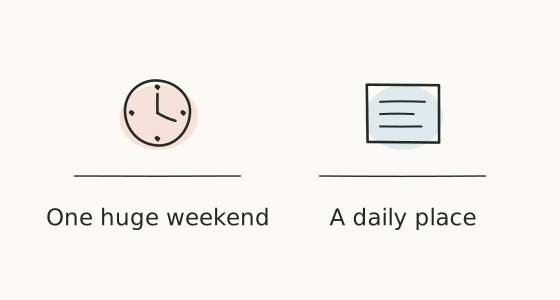
There are real choices inside those routines. Five hours of freelance work has to come from somewhere. Three runs have to fit around the rest of the week. Looking at the daily behavior lets you see what you would need to change and what is reasonable to ask of yourself now.